
OpEd- The Government Creates the Dollar. So Why Are We Acting Broke?
Published by Appalachia Insider · May 11, 2026
This opinion piece was contributed to Appalachia Insider. The views expressed are those of the author and do not necessarily reflect the views of Appalachia Insider.
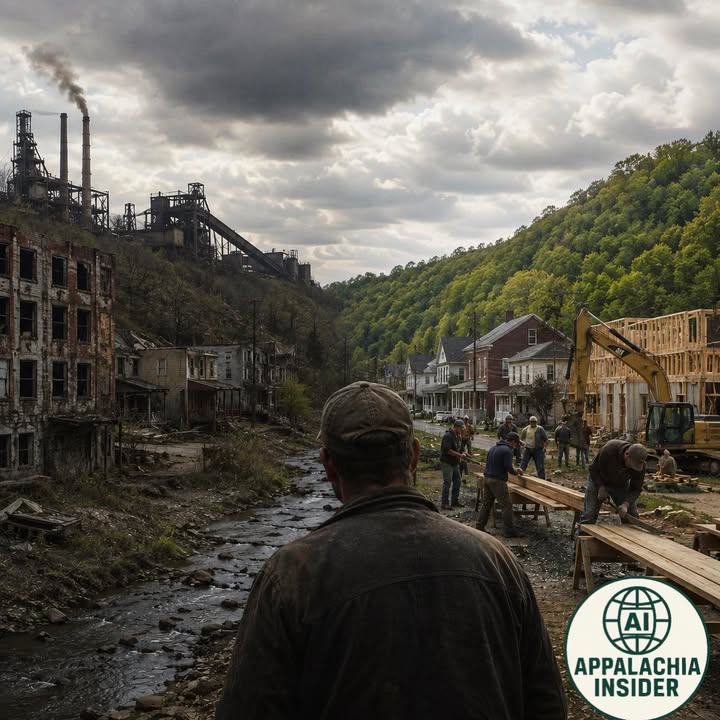
If you want to understand the failure of modern economics, spend some time in Eastern Kentucky.
Drive through towns with leaking water systems and roads still scarred from floods. Pass abandoned industrial sites and neighborhoods where young people leave because opportunity left before they did. Talk to welders, mechanics, truck drivers, miners, nurses, builders, and tradesmen who still know how to work, still know how to build, and still know how to keep a place alive long after much of the country stopped paying attention.
Then listen as politicians stand in front of all of it and say, “We just can’t afford to fix it.”
That belief sits at the center of modern American politics. Most people think the federal government works like a household or a business. That before it can spend a dollar, it first has to collect one in taxes, borrow one from somewhere else, or pull one out of some giant vault hidden away in Washington.
But that is not how the system actually works.
The United States government is the issuer of the dollar itself. Federal spending creates dollars. Taxes do not fund that spending in the way most people imagine. Their role is different. Taxes help regulate inflation, remove excess liquidity from the economy, discourage destructive behavior, and steer resources toward productive uses.
Households are users of currency. Businesses are users of currency. Cities and states are users of currency. The federal government is the issuer of it.
That is not ideology. It is the operational reality of a modern fiat monetary system.
And once you understand that, the conversation changes completely.
The real limits facing a country are not numbers sitting on a spreadsheet. The real limits are labor, energy, materials, productive capacity, logistics, infrastructure, technology, and inflation. A country with unemployed workers, underused factories, failing infrastructure, and abundant untapped resources is not broke. It is badly organized.
Eastern Kentucky understands this better than most places because we have lived through it firsthand.
This region is filled with people who know how to build, weld, haul, repair, mine, manufacture, transport, and work. The problem was never that the people disappeared. The problem was that productive capacity was abandoned without anything stable built in its place.
For decades, communities across Appalachia were told there was never enough money to modernize water systems, strengthen flood infrastructure, rebuild industry, expand housing, or create long-term stability. Meanwhile, trillions of dollars appeared almost instantly whenever financial markets or major institutions needed protection.
People notice that contradiction.
Apparently the country is only “out of money” when ordinary towns need rebuilding.
That does not mean taxes are unimportant. Taxes matter tremendously, but their purpose is different than most people imagine. Taxes exist to help manage the temperature of the economy itself.
When too much money begins chasing too few goods and services, inflation rises. Taxes help pull excess demand back out of circulation. When speculation becomes more profitable than manufacturing or productive investment, taxes can shift incentives back toward real economic activity. When wealth concentrates so aggressively at the top that broad circulation begins weakening underneath it, taxation can help restore balance.
That is what taxation is ultimately for. Not punishment. Not revenge. Not confiscation. It exists to maintain stability within the system and prevent excesses that distort the broader economy.
The problem is that we have spent decades rewarding the wrong behavior.
We often place heavier burdens on productive labor and domestic industry than we do on speculative finance and unproductive extraction. Wealth pools into stagnant financial assets while factories close, supply chains weaken, and entire towns hollow out around them.
And then we act surprised when the country itself begins to feel fragile.
None of this means spending is limitless. Inflation is real. Resource shortages are real. Productive capacity matters. Reality still applies whether politicians acknowledge it or not.
We saw exactly what mismanagement looked like after 2020 and 2021. Massive amounts of money entered the economy while supply bottlenecks, labor shortages, energy instability, and production constraints were already building underneath the surface. Inflation followed because productive capacity did not expand fast enough to absorb the demand.
The lesson was never that government spending itself is inherently evil. The lesson was that spending disconnected from productive expansion creates instability.
That is where Stewardship Economics parts ways with both blind austerity and reckless spending. Stewardship is not about throwing money blindly into the economy and hoping for the best. It is about directing currency toward productive investment that strengthens the country’s long-term ability to function.
That means reliable energy, modern infrastructure, housing supply, domestic manufacturing, skills training, transportation systems, and industrial resilience. It means using taxation not simply to collect revenue, but to discipline speculation, discourage destructive concentration, and keep the broader economy balanced and functional.
Most importantly, it means measuring success by what we are actually capable of building together instead of obsessing over arbitrary deficit numbers disconnected from real economic conditions.
Because money itself is not the wealth.
The real wealth is the productive capacity behind it. The factories capable of producing goods. The workers willing to labor. The power grid keeping the lights on. The roads connecting mountain communities. The farms feeding families. The welders, mechanics, miners, truck drivers, builders, nurses, teachers, and tradesmen holding entire regions together every single day.
Those things are the real economy.
Money is simply the coordination tool that allows those efforts to move together toward a shared purpose.
And once you understand that, failure can no longer be blamed on some mythical empty vault in Washington. Failure becomes what it always truly was: poor stewardship, corruption, short-term political thinking, and the chronic misallocation of real resources.
We are not trapped by gold reserves. We are not trapped by household-budget myths. We are not trapped by the false idea that millions of Americans must struggle simply because politicians pretend numbers on a spreadsheet are more real than the people standing in front of them.
The federal government issues the currency.
Our responsibility is making sure the system built with it actually serves the people living inside it.
~CA
OpEd: The preceding information does not necessarily reflect the views of Appalachia Insider as an organization.
#AppalachiaInsider #EasternKentucky #StewardshipEconomics #Appalachia #Economy #Infrastructure #AmericanIndustry #FiscalPolicy #MMT #EconomicReality