
OpEd- Eastern Kentucky Doesn’t Lack Work. It Lacks the Structure to Do It.
Published by Appalachia Insider · July 12, 2026
This opinion piece was contributed to Appalachia Insider. The views expressed are those of the author and do not necessarily reflect the views of Appalachia Insider.
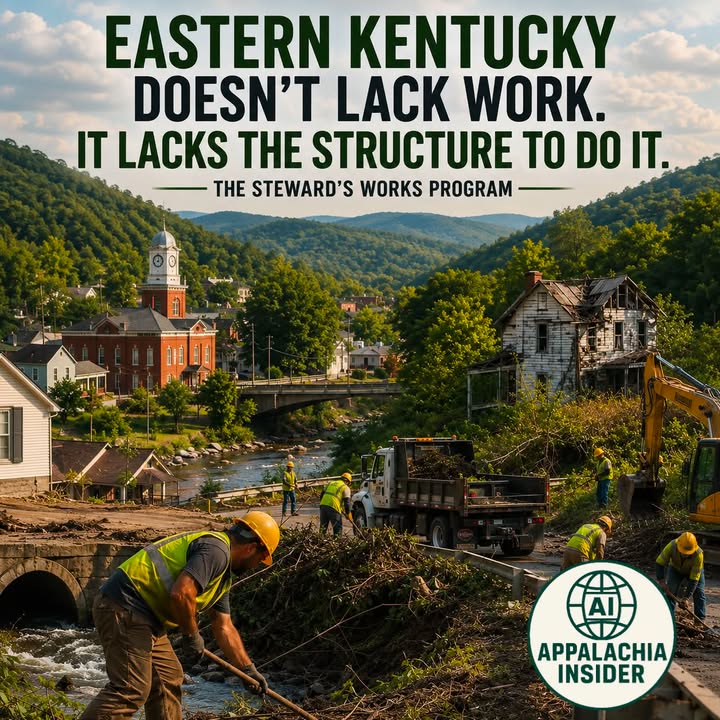
The Steward’s Works Program
Eastern Kentucky does not suffer from a lack of problems that need solved.
You can see them almost everywhere you drive.
A culvert clogged for years.
A drainage ditch overtaken by brush.
A bridge patched together again and again because replacement is always one budget cycle away.
An abandoned home slowly collapsing while a nearby family searches for something affordable.
These are not rare problems. They are ordinary ones.
Ask any county official and they will tell you the same thing. The list of needed work is endless. What’s missing is the labor and the funding to do it.
At the same time, thousands of people across the region want steady work and cannot find it. Others leave entirely because opportunity exists somewhere else.
Two realities sit side by side in Eastern Kentucky every day.
Work that needs done.
People who want to do it.
Yet our system rarely connects the two.
Instead, counties patch together contracts when funding appears. Outside companies complete the work if the bid is profitable enough. When it isn’t, the projects wait. Sometimes for years.
What Eastern Kentucky lacks is not effort. It is structure.
That structure could be called the Steward’s Works Program.
Under this model, participating counties would form a regional workforce authority through interlocal cooperation under Kentucky law. That authority would hire workers and deploy crews to projects requested by participating counties.
Instead of each county scrambling independently for contractors, the region would maintain its own standing public works workforce.
These crews would focus on work that rarely attracts private bids but produces enormous public benefit. Clearing drainage systems before floods arrive. Repairing rural culverts and roads. Stabilizing hillsides. Rehabilitating aging housing. Removing abandoned structures.
Across Eastern Kentucky, these problems remain on the list year after year.
There is also a simple economic truth behind focusing on this kind of work.
Routine maintenance is far cheaper than delayed replacement. A culvert cleared today prevents a washed-out road tomorrow. Stabilizing a hillside early can prevent millions of dollars in damage later.
The work that often goes undone in rural communities is frequently the work that saves the most money in the long run.
A Steward’s Works Program would allow counties to fix problems early instead of paying far more after failure.
It would also strengthen the local economy in ways many people overlook.
When a public works program offers a reliable living wage, it creates a wage floor. Private employers must compete for workers by offering better pay or conditions. Over time, wages begin to rise across the region without mandates or complicated regulations.
Just as important, the money earned by those workers stays in the local economy. Families spend those wages locally, and the economic ripple spreads outward instead of disappearing somewhere else.
Critics will ask the obvious question.
How do we pay for it?
The reality is that Eastern Kentucky already receives significant federal investment through infrastructure programs, disaster mitigation grants, housing initiatives, and regional development efforts administered by agencies like the Appalachian Regional Commission, the Economic Development Administration, and FEMA.
The United States operates under a modern fiat monetary system. The federal government issues the currency used throughout the economy and spends it into circulation through programs like these.
In practice, Washington already directs billions of dollars toward regions like Appalachia.
The problem is not that these dollars never reach Eastern Kentucky.
The problem is that they often leave just as quickly.
Outside contractors complete the work. Outside suppliers provide materials. Outside firms capture the profits. The money passes through our communities instead of building them.
A regional workforce authority would allow far more of those dollars to circulate locally.
Instead of hiring outside crews every time a grant arrives, the Steward’s Works Program would provide the workforce capable of performing much of that work directly.
The same federal dollars would still fund the projects.
But the wages and economic activity would remain here.
This program would also complement existing workforce training efforts in the region. Organizations already help residents gain skills and credentials. The Steward’s Works Program would provide a direct pathway from training into real projects that improve the region itself.
It would also focus on work the private market rarely performs. Small infrastructure repairs, routine maintenance, and housing rehabilitation often remain undone because they are too small or too dispersed to attract private bids.
By focusing on this “orphan work,” the program strengthens communities without competing with local contractors.
And it would not require every county to join at once.
Programs like this usually begin with a small example.
Counties such as Magoffin and Johnson already face many of the same challenges and opportunities. A small partnership between neighboring counties could demonstrate how a Steward’s Works Program might operate.
A few crews.
A short list of visible projects.
A clear public record of what gets done and what it costs.
If the results are strong, other counties will not need to be convinced. They will ask to participate.
The idea itself is not new. During the Great Depression, programs like the Works Progress Administration and the Civilian Conservation Corps put millions of Americans to work building infrastructure that still serves the country today.
But a Steward’s Works Program for Eastern Kentucky would operate under local control.
The priorities would not be set in Washington. They would be set by the communities that live with the results.
And it would follow the same principle that guides Stewardship Economics: the Pragmatic Path.
Policies should not be judged by ideology. They should be judged by results.
Each quarter, participating counties would publish a simple public scorecard.
How many local workers are employed.
How much income stays in the regional economy.
How many infrastructure problems are solved.
If the results improve, the program continues. If they do not, it changes.
That is the Pragmatic Path in practice.
Eastern Kentucky does not lack workers.
It does not lack work that needs done.
What we have lacked is the structure to bring those two things together.
It may be time to build it.
~CA
OpEd: The preceding information does not necessarily reflect the views of Appalachia Insider as an organization.
#AppalachiaInsider #EasternKentucky #StewardshipEconomics #AppalachiaRising #LocalSolutions #RuralRevival