
OpEd- We Already Live in the World They’re Afraid Of!
Appalachia Insider · August 21, 2026
I was watching a discussion this morning about the national debt, Treasury bonds, rising yields, and the federal government buying back some of its own debt. The concern was understandable. The United States has crossed $40 trillion in national debt. Interest costs are enormous. Long-term Treasury yields have risen. We are running large deficits, and there are legitimate questions about where all of this eventually leads.
But somewhere in the discussion, something started bothering me.
They began talking about the government buying back Treasury securities and asked where the money was coming from. Are we printing money to buy our own debt? The answer was essentially yes, and the reaction was immediate.
That’s crazy.
You can’t print your way out of this.
We’re running out of bullets.
Who is going to bail us out?
I understood the concern. What bothered me was the premise underneath it.
We already live in that world.
The United States abandoned gold convertibility a long time ago. Our dollars are not claims on some fixed pile of gold sitting in a vault, and there is no finite supply of dollars that the federal government slowly works its way through until the cupboard is bare. We operate a fiat monetary system. New dollars are created throughout that system every day.
That isn’t something I’m proposing. It isn’t some radical monetary experiment I want America to try.
It is the world we already live in.
And yet much of the language we use to understand that world still comes from one where money itself was scarce. We talk about the federal government like a family sitting around the kitchen table trying to decide whether there is enough money in the checking account to fix the roof. We talk about the national debt like a giant credit card bill that will eventually arrive in our grandchildren’s mailbox.
I understand why. I have to earn dollars before I can spend them. So do you. Kentucky has to raise or obtain dollars before it can spend them. Businesses do too. We live our entire lives as users of the currency, so it is natural to assume the issuer of that currency lives under the same rules.
It doesn’t.
That does not mean there are no limits. There absolutely are. But once you stop pretending the dollar itself is the scarce thing, the limits become much more serious because they are things we cannot create with a keystroke.
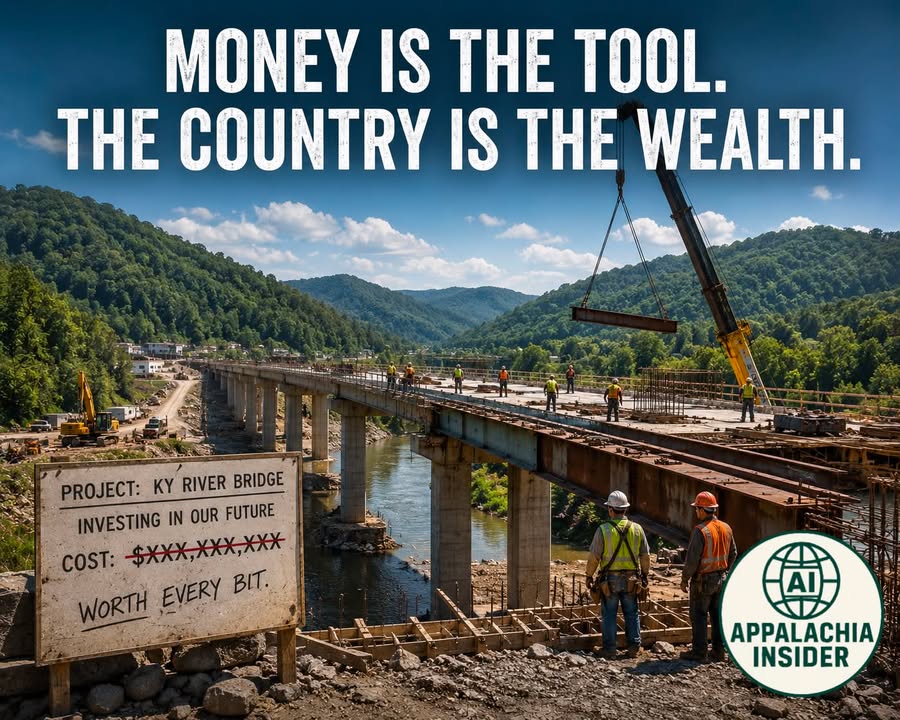
Suppose America wants to build a bridge. We can debate the appropriation. We can argue about taxes, Treasury securities, interest rates, and the accounts the dollars move through. Those are real institutions, and they have real consequences.
But they are not the bridge.
The bridge is steel. Concrete. Engineers. Equipment operators. Electricians. Fuel. Machinery. Land. Time. It is thousands of hours of human labor and a supply chain capable of putting all of those things in the same place at the same time.
That is real scarcity.
If the workers are available, the steel can be produced, the equipment exists, and the economy has the capacity to build the bridge, then I have a hard time accepting that the thing stopping us should be an artificial shortage of a currency the country itself issues.
But if those resources are already being used somewhere else, creating more dollars does not create another steel mill. It does not create another engineer. It does not put another hour in the day. It creates additional claims on things that are already scarce, and eventually the price of those things rises.
That is where the discipline lives.
Recognizing monetary sovereignty is not an argument for unlimited government spending. It is almost the opposite. It removes one of the easiest excuses government has and forces us to ask harder questions.
Do we have the capacity to do this?
What resources will it consume?
What are we pulling those resources away from?
What will remain when the spending is over?
And was it worth it?
Those are questions of stewardship.
That is also how I have started thinking about the $40 trillion national debt. I do not dismiss it. A number that large deserves attention. So do the interest payments attached to it and the signals coming from the bond market. But staring at the number alone tells us far less about the condition of the country than we pretend it does.
I want to know what we got for it.
Imagine two countries. Each adds a trillion dollars to its public debt. One uses the resources it commands to build power plants, roads, bridges, water systems, factories, ports, research facilities, and schools. It trains engineers and tradesmen. It increases energy production. It leaves behind assets capable of producing value for decades.
The other spends the same trillion dollars and has almost nothing to show for it ten years later.
The ledger records the same additional liability.
The countries are not remotely in the same condition.
One helped build the future.
The other simply sent the bill there.
That distinction gets lost when we reduce fiscal responsibility to the size of a number. It is also why I have trouble with the warning that our children and grandchildren are simply going to have to pay for everything we are doing today. There is truth buried inside that warning. They will inherit obligations we create, and there is nothing responsible about handing future generations liabilities for things that gave them nothing lasting in return.
But they inherit the other side too.
They inherit the roads. The power plants. The technology. The knowledge. The factories and businesses that grew because infrastructure existed to support them. They inherit the skills we taught, the institutions we strengthened, and the productive capacity we built.
And they inherit what we failed to build.
I can drive through Eastern Kentucky and see those liabilities everywhere, even though none of them appear on the national debt clock. An aging water system is a liability. A bridge we keep patching because replacement costs too much is a liability. A town that lost its industry and never developed another productive base is a liability. A generation of skilled workers we never trained is a liability. An electric grid that cannot carry the economy we expect to build twenty years from now is a liability.
Refusing to spend money does not make those costs disappear.
It sends those bills forward too.
There are liabilities that never appear on the national debt clock.
That does not mean every government program becomes an investment because a politician calls it one. Governments waste money. They spend for political convenience. They protect programs long after the programs stop working. They subsidize industries with enough influence to get themselves called essential. They can create enormous amounts of financial activity while leaving very little real value behind.
The ability to create money does not excuse any of that.
It makes the failure worse.
If dollars themselves are not the thing we are ultimately short of, then every dollar of public spending should face a more demanding question: what real thing did we command with it, and what did we leave behind?
That is where the Pragmatic Path comes into this for me. I do not want an economic philosophy that already knows the answer before the question is asked. I care about what happens after we do something. Are people happier? Are their lives more stable? Do they have purpose, meaningful work, and a reason to believe there is something worth building toward?
Then ask again.
A year later. Three years later. Five years later. Ten years later.
If it did not work, change it. If it did work, do not abandon it because somebody’s ideology says it was not supposed to.
The same should be true of the monetary system itself. Treasury securities serve useful purposes. Keep the purposes that work. Taxes do far more than collect money. Use them with intention. Monetary institutions provide discipline and stability. Preserve the discipline that produces good outcomes.
But none of those institutions descended from the mountain written on stone.
We built them.
And if we built them, we are allowed to ask whether they still serve us well.
That was what bothered me about the discussion this morning. They were talking about money creation as though America had suddenly discovered some dangerous loophole in economics, like the government had found a printing press hidden in a back room and decided to start cheating.
We didn’t suddenly discover any of this.
We already operate this way.
We remember that when financial markets seize up. We remember it when banks are threatened. We remember it during war. We remember it when the country decides something is important enough that failure is not an option.
Then, somehow, when the conversation turns to infrastructure, housing, energy, manufacturing, or rebuilding communities that have been hollowed out for generations, we find ourselves back around the kitchen table staring into a checkbook and asking where the dollars are supposed to come from.
That contradiction is what I cannot get past.
The question is not whether America possesses monetary power. It already does.
The question is whether we are mature enough to admit what that power is, recognize what actually constrains it, and govern ourselves accordingly.
Because $40 trillion is an extraordinary financial obligation. I am not interested in pretending otherwise.
But show me the other side.
Show me the power plants. Show me the bridges. Show me the factories and machine shops. Show me the water systems that will last another fifty years. Show me the welders, machinists, engineers, electricians, and linemen we trained. Show me the stronger towns. Show me the research that became industry. Show me the productive capacity our grandchildren will inherit alongside every Treasury security carrying their future forward.
And where we cannot point to those things, maybe our failure was not simply that we spent too much.
Maybe we spent without building.
Maybe we consumed tomorrow without preparing for it.
Maybe the real scandal of $40 trillion is not that America found forty trillion dollars to spend, but that after all of it, we can still drive through towns with broken water systems, abandoned factories, aging bridges, empty storefronts, and people being told there simply is not enough money to fix what is falling apart around them.
Our grandchildren will inherit our debts.
But they will inherit our country too.
The roads we built and the ones we neglected. The factories we kept and the ones we allowed to disappear. The skills we taught and the ones we forgot. The communities we strengthened and the ones we watched slowly empty.
That is the balance sheet I care about.
Money is the tool.
The country is the wealth.
And stewardship is what we leave behind.
~CA
OpEd: The preceding information does not necessarily reflect the views of Appalachia Insider as an organization.
#AppalachiaInsider #OpEd #StewardshipEconomics #NationalDebt #AmericanEconomy #EasternKentucky