
OpEd-Before Someone Else Decides What This Becomes
Published by Appalachia Insider · September 9, 2026
This opinion piece was contributed to Appalachia Insider. The views expressed are those of the author and do not necessarily reflect the views of Appalachia Insider.
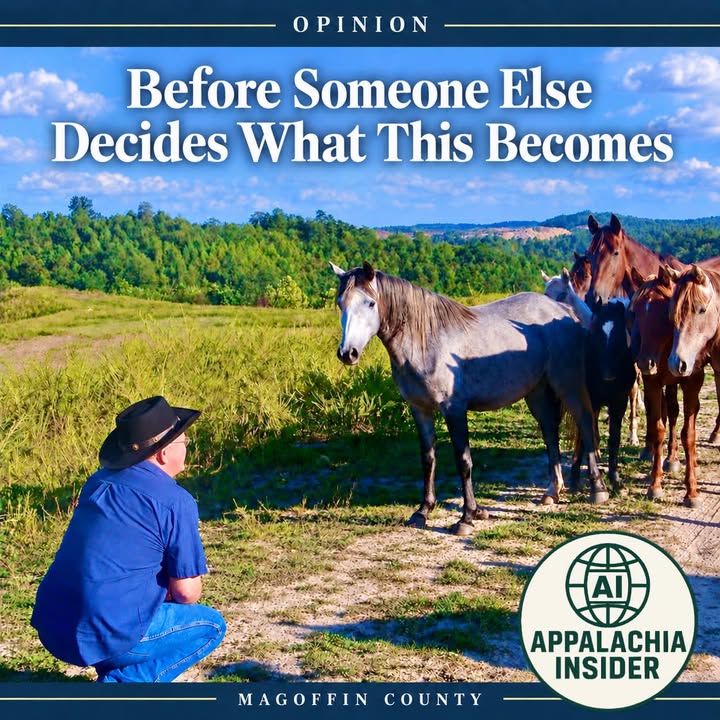
A few years ago, I started looking at the ridge that runs from the Route 30 side of Magoffin County toward Royalton and Tip Top and wondering why we did not see it differently.
There was already a maintained road across the mountain. People were already riding four wheelers, side by sides, and horses there. Much of the surrounding land had already been mined and reclaimed, leaving unusually large areas of relatively flat ground in a place where flat ground has always been one of our scarcest resources.
At the other end sat Royalton, the Dawkins Line Rail Trail, and the Tip Top Tunnel.
It seemed obvious to me that we were looking at more than an old fire trail. We were looking at the beginning of something, if we were willing to recognize it.
I wrote then that we should build trailheads, run utilities along the ridge, connect the pieces we already have, and create the conditions for private development to follow. Cabins, campgrounds, horse facilities, stores, repair shops, places to eat, and places to stay. Things that could be owned by people who live here and supported by people who come here to enjoy what we already have.
What concerned me then was that we were sitting on an opportunity without treating it like one. What concerns me now is that someone else may recognize the opportunity whether we do or not.
A dispute unfolding around hunting leases on local land caught my attention because beneath all of the arguing is something much larger. Someone has looked at land in our area and decided that access to it has value. Hunting rights are being leased. Customers are being brought into the area. Access to land that many people here may have driven past, hunted around, or ridden across for generations is now being packaged and sold as a recreational product.
There is nothing inherently wrong with that. Private landowners have every right to seek income from their property, and I want local landowners to find productive uses for land that may otherwise provide them very little. If someone can earn dependable income from property their family owns, that can be a good thing. But it should make the rest of us think about what is happening around us.
I also understand the people who say they do not want to be developed. Appalachia has been developed before, usually according to somebody else’s idea of what our land was worth and what our communities should become. Nobody wants to wake up one morning and discover that the place they have known their entire life has become somebody else’s business plan. Nobody wants to lose access they believed they had, or suddenly find strangers driving past their home every weekend. That resistance is not foolish. In many ways, it comes from experience.
But saying we do not want development does not freeze Magoffin County in time. Private landowners can still lease their property. Property changes hands. Children inherit it. Markets change. What makes little economic sense today may make a great deal of sense a few years from now. Doing nothing does not stop change. It only gives us less influence over what that change looks like.
That is why I am not arguing that somebody should come develop Magoffin County. I am arguing that Magoffin County should decide how it wants to develop itself. Local people need to be part of that conversation because development that ignores the people who already live here is exactly the kind of development Appalachia has experienced too many times before.
For most of our history, Appalachia has had no shortage of valuable things. Our problem has too often been recognizing their value late, organizing around them late, and discovering after the fact that someone else had already figured out how to make money from what was sitting beneath our feet. Coal was valuable. Timber was valuable. Mineral rights were valuable. Land was valuable. Again and again, someone recognized what we had, organized capital around it, and created a system capable of turning it into money. The people who lived here worked in those systems and sometimes prospered from them, but ownership, control, and much of the lasting wealth often ended up somewhere else.
I do not want us to repeat that pattern with the next Appalachian economy.
Outdoor recreation is coming whether Magoffin County develops a plan for it or not. People already ride these mountains. People already hunt them. People already travel to Eastern Kentucky looking for places to ride, hunt, camp, hike, and spend a few days away from wherever they came from. Hunting leases are another indication that the market is beginning to recognize something we have treated as ordinary for generations.
The mountain itself has value now, not simply what can be taken out of it.
That creates an opportunity, but it also creates a question. A hunter can spend a thousand dollars to hunt in Magoffin County without a thousand dollars ever circulating through Magoffin County. He can arrive with fuel in the truck, food in a cooler, stay on leased property, hunt for several days, and leave. Economic activity happened here, but very little economy was necessarily built here.
Stewardship asks what remains after the money moves. Did a local landowner earn income? Did a local family own the cabin where the visitor stayed? Did someone in Salyersville sell the fuel? Did a restaurant gain a customer? Did somebody open a repair shop because enough riders were coming through to support one? Did infrastructure built for recreation make another piece of land useful for something else? Did the activity leave Magoffin with more productive capacity than it had before?
That is why I still believe the ridge matters. Not because one trail will save Magoffin County, and not because tourism will replace every industry we have lost. It matters because the ridge represents the kind of opportunity we have too often failed to organize around until someone else did it first. We have the land, the trail, the Dawkins Line, Tip Top, reclaimed mine land capable of supporting development, and people who are already coming here. What we do not yet have is a deliberate system that makes sure their presence creates something lasting.
That means building trailheads, mapping and clarifying routes, protecting legitimate public access while respecting private property, extending utilities where doing so can open land for productive use, and making it easier for local people to build cabins, campgrounds, stores, stables, repair businesses, and other recreation services. It means connecting visitors to Salyersville instead of allowing them to pass around it. It means welcoming outside investment when it adds to what local people are building, instead of waiting until outside investment determines what gets built.
Someone from Ohio seeing value in Magoffin County is not the problem. In many ways, that is proof that the opportunity is real. The problem would be everyone else recognizing that value while we continue pretending there is nothing here worth organizing around.
Markets do not wait for communities to decide they are ready. Once land begins being leased, access begins being sold, and recreation traffic becomes established, the direction of development becomes harder to change. We do not need to stop development. We need to get ahead of it.
We have spent generations talking about what was taken from Appalachia. Maybe this time we should spend a little more time thinking about what is coming next, while we still have the opportunity to shape it.
Because if we do not, development will probably come anyway.
It just may not happen for us.
It may happen to us.
~CA
OpEd: The preceding information does not necessarily reflect the views of Appalachia Insider as an organization.
#AppalachiaInsider #MagoffinCounty #EasternKentucky #OutdoorRecreation #EconomicDevelopment #StewardshipEconomics