
OpEd-We Keep Turning the Valve, But the Water Is Still There
Published by Appalachia Insider · October 7, 2026
This opinion piece was contributed to Appalachia Insider. The views expressed are those of the author and do not necessarily reflect the views of Appalachia Insider.
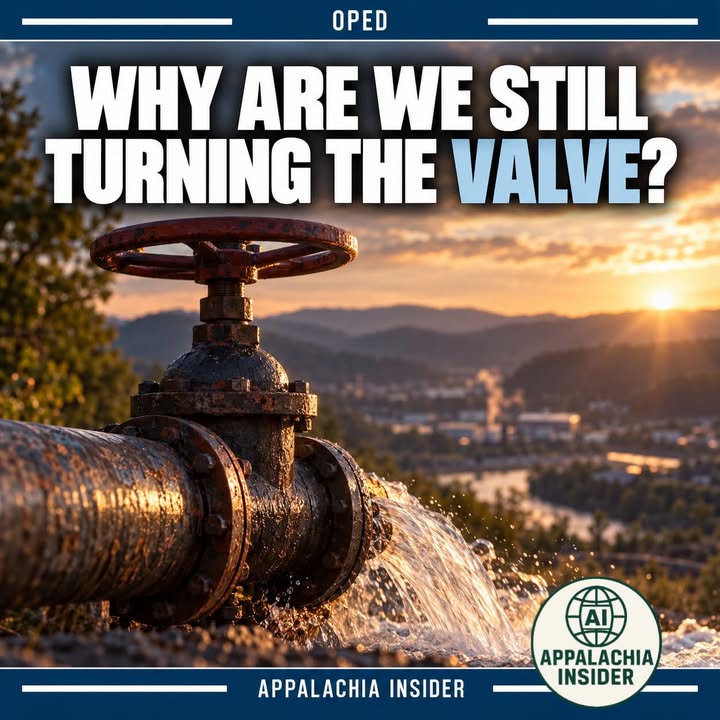
I was watching a video this evening in which Jamie Dimon talked about inflation staying “sticky” and the possibility that interest rates could keep rising. I kept coming back to the same question. Why?
Not why the Federal Reserve raises rates. I understand the theory. Make borrowing more expensive, slow spending, cool the economy, and eventually inflation comes down. There are practical reasons it is the tool we reach for. The Fed can move quickly, it acts without waiting on Congress, and raising taxes is politically painful. But those explain why the tool is convenient. They do not explain why it should be the first answer, when it seems to leave the underlying problem sitting there waiting on us.
If people have too much purchasing power relative to the goods and services available, higher rates do not directly remove most of it. They can destroy some demand through weaker credit, investment, employment and income, but much of the immediate effect is to postpone spending. A family waits another year to buy the house. A business delays the expansion. Someone leaves money in savings because the return is better. Then conditions change and some of that purchasing resumes.
I kept thinking about water. If you have too much water for the container, you have two obvious choices. Remove some water or make the container bigger. Interest rates are a valve. Turning it slows the flow, but the water is still in the pipe. We leave the nominal purchasing power in place, raise the cost of using it, weaken parts of the economy until spending slows, and then call the slowdown success. Meanwhile, higher rates make housing more expensive to build, discourage business investment, raise financing costs throughout the economy, and increase interest income flowing to people who already hold financial assets.
That is the part I cannot get past. If the problem is too much nominal purchasing power relative to the real economy, why not deal with the imbalance itself?
The more I thought about it, the more I came to believe we misunderstand taxation because we misunderstand federal money. Most of us grow up thinking of the federal government as a very large household. It collects taxes, puts the money in an account, and pays its bills from that account. If it wants to spend more than it collected, it has to borrow the difference. If government gets too big, cut the taxes and eventually it runs out of money and shrinks.
“Starve the beast” only makes sense if you assume federal taxation is what gives the federal government the dollars it spends.
But the federal government, operating through the Treasury and Federal Reserve within the laws Congress has created, is not financially constrained the way a household, business, state or local government is. Its ultimate constraint is not whether dollars exist. It is whether the real resources exist to absorb the spending without pushing nominal demand beyond what the economy can actually produce.
Workers. Machinery. Energy. Materials. Land. Knowledge. Factories. Housing. Doctors. Engineers. Roads. Electricity. Time.
Those are the things that are actually scarce. Money is the instrument we use to organize claims on them.
Seen that way, taxation makes more sense too. At the national level, taxes do not have to be understood primarily as money collected before spending can happen. Taxation also removes purchasing power from the economy. That makes it a maintenance tool.
We already do some of this automatically. Tax collections rise as incomes rise, and some government support falls as employment improves. When the economy weakens, the process runs in reverse. But we wait until inflation is already here to do anything more. By the time prices are rising broadly enough for everyone to agree there is a problem, the imbalance has already developed. Then we reach for the brake and slow the economy after the fact. It feels less like maintenance and more like waiting for the engine to overheat before checking the coolant.
If we can see nominal demand starting to outrun productive capacity, the drain should begin early and gradually. Picture a fiscal adjustment that phases in when a basket of indicators begins to show that nominal demand is pressing against available capacity, then automatically phases back out when that imbalance eases. The exact thresholds, indicators and tax base would have to be designed carefully, because there is no single gauge that can tell us everything we need to know. But the important part is that the rules would exist before the crisis arrived. No giant tax bill every six months, just mechanisms written in advance that respond to conditions and reverse themselves when those conditions change.
But removing water is only half the answer. Sometimes the container really is too small.
That is where our misunderstanding of federal money becomes expensive. We argue constantly about whether government can afford to invest in research, manufacturing, energy, infrastructure or housing. Those arguments begin with dollars when they should begin with capacity. Do we have the engineers? The labor? The raw materials? Can we produce the energy? Can the economy absorb the work without pulling too many resources away from something else?
If the answer is yes, the lack of dollars should not be what stops us. If the answer is no, having the dollars does not fix it. Printing money does not make us richer. Producing more things worth having does.
The federal government can fund basic research that may not pay off for twenty years. It can help promising technology make the jump from laboratory to factory floor. It can build the roads, power systems and communications networks private businesses need before they can invest. It can support domestic manufacturing where real capacity is missing and train the workers to staff it. That is not replacing private competition. It is helping create the conditions in which businesses innovate, hire, fail and succeed.
More housing. More energy. Better medicine. Better transportation. More goods and services produced with less human effort. A country that can do more tomorrow than it could today is richer in a way that has nothing to do with the number printed on a dollar.
That is where this circles back to the Pragmatic Path for me.
The Pragmatic Path is not an economic theory, and it is not another ideology competing for a place on the spectrum. It is a way of looking at a problem without first asking which side is supposed to own the answer. Start with the outcome, look honestly at the tools available, measure the results, and change course when those results are not improving people’s lives. We measure through three pillars, Happiness, Stability and Purpose, at one, three, five and ten years, because something that feels good in year one but leaves people less stable in year five is not a success.
Stewardship Economics is where that method becomes an economic philosophy. The Pragmatic Path is the compass and the measurement. Stewardship Economics asks what kind of economy can sustain the improvements we are measuring. Did we consume productive capacity or expand it? Did we leave infrastructure stronger or weaker? Did we create knowledge, technology, businesses and institutions the next generation can build on, or did we move numbers around and call it growth?
That is why I do not much care which school gets credit. Some of this sounds like Modern Monetary Theory. Some sounds like Functional Finance. Some is industrial policy. Some sounds suspiciously like traditional supply-side economics. Economists can argue over the labels for years.
I am more interested in whether it works. If nominal purchasing power begins to outrun the real economy, drain some of it. If productive capacity is insufficient, build more. If both are happening, do both. If a policy works, keep it. If the results move in the wrong direction, change it.
We did not create the productive capacity, infrastructure, institutions, knowledge and resources we inherited. We are temporary stewards of them. Our job is not to consume what was left to us. Our job is to add to it.
A balanced federal spreadsheet can sit beside collapsing bridges, unaffordable housing, an unreliable grid, abandoned factories and communities with no economic future. I do not call that responsible just because the ledger looks tidy. But spending simply because the government has the ability to create money is no more responsible. Every increase in net nominal purchasing power creates claims on the economy’s real output, and those claims have to stay in reasonable relationship with what the country can produce.
That is why taxation still matters. That is why inflation still matters. That is why waste still matters. They are all parts of a larger question.
Maybe that is what bothered me so much about the video tonight. We keep talking about whether inflation will stay sticky and whether rates will have to rise again, as though our only choice is how hard and how long to press the brake.
I keep wondering why we are not spending more time asking whether we can fix the road.
~CA
OpEd: The preceding information does not necessarily reflect the views of Appalachia Insider as an organization.
#AppalachiaInsider #OpEd #StewardshipEconomics #PragmaticPath #Inflation #InterestRates #EconomicPolicy #FederalReserve