
THE SALYERSVILLE INDIAN COMMUNITY: A HISTORY HIDDEN IN PLAIN SIGHT
Appalachia Insider · November 10, 2026
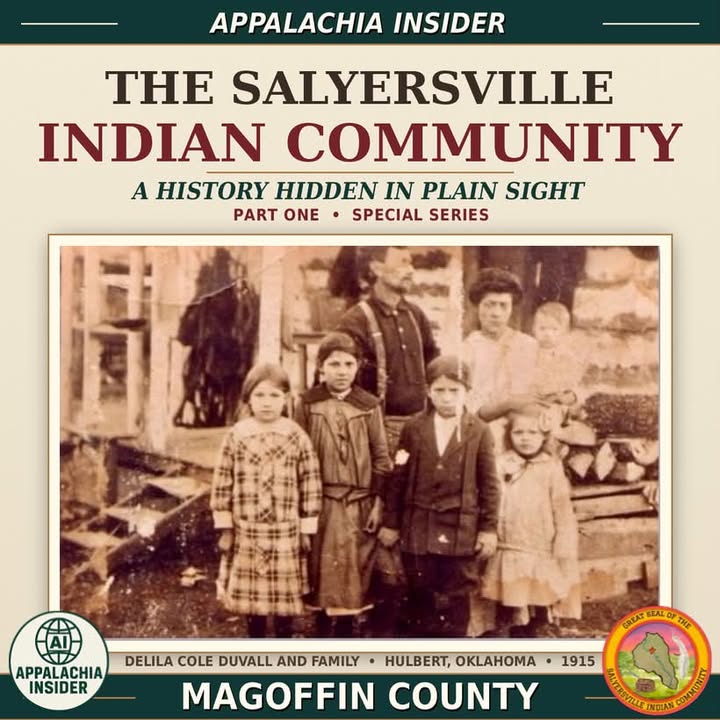
Part One of an Appalachia Insider Special Series
In the mountains of Eastern Kentucky, few questions are more familiar than, “Who’s your people?”
It’s a question rooted in generations of family connections, where knowing someone’s grandparents or the creek they came from can reveal a shared history that stretches back further than either person might realize.
But some of those histories are far more complicated than the family names we’ve come to recognize.
For generations, an Indigenous community has maintained its identity and connections to the hills of Magoffin County, its history preserved through family relationships, historical documents, and traditions that survived migration, economic hardship, and the passage of time.
That community, known today as the Salyersville Indian Community, has roots in Eastern Kentucky dating back to before Magoffin County itself was established.
And while its history may be unfamiliar to many residents, the community’s existence is not a recent discovery.
On June 16, 2026, the Magoffin County Fiscal Court formally recognized the Salyersville Indian Community as a distinct, historic, and active Indian tribal community, acknowledging its documented presence in the region since at least the 1820s.
The resolution marked an important development in the community’s ongoing efforts to preserve its history and obtain federal acknowledgment. But it also brought renewed attention to a part of Magoffin County’s past that has received relatively little recognition in the broader public understanding of the region.
A HISTORY THAT BEGAN BEFORE MAGOFFIN COUNTY
The origins of the Salyersville Indian Community reach into the history of Indigenous families who traveled through Virginia, North Carolina, and Tennessee before establishing permanent settlements in Eastern Kentucky during the nineteenth century.
Research conducted by anthropologist Dr. Richard Allen Carlson Jr., whose doctoral dissertation Who’s Your People? examines the community’s history from 1677 through 2000, identifies three principal family lines involved in its formation: Cole, Collins, and Gibson.
Carlson’s research traces the Collins family to the Christian Saponi, descendants of an Indigenous people who maintained treaty relationships with colonial Virginia. Following the loss of their reservation lands and the gradual dispersal of their population, groups of Saponi families moved through the Appalachian region, establishing communities along the Virginia, North Carolina, and Tennessee borders.
The Cole and Gibson families became closely associated with these descendants through intermarriage, shared residences, and family relationships. Although historical accounts sometimes identify their ancestry as Cherokee or Catawba, those specific tribal connections remain unconfirmed, a distinction acknowledged in the community’s own federal recognition petition.
By the early 1800s, members of these interconnected families had begun establishing themselves in Eastern Kentucky.
Over the following decades, they acquired land around Big Lick, Cole Creek, Bear Branch, and Jenny’s Creek, near the present-day boundaries of Magoffin, Floyd, and Johnson counties.
By the years preceding the Civil War, these settlements had become the center of a distinct community whose families continued living alongside one another, maintaining close relationships and establishing roots that would extend through generations.
Some of those same family names remain familiar throughout Eastern Kentucky today.
THE COLE NATION
The historical evidence becomes particularly revealing around the turn of the twentieth century.
In 1900, the federal census included a separate Indian Population Schedule for the Salyersville District of Magoffin County.
According to Carlson’s research, 83 people living in 15 households were recorded as Indian, primarily in the area around Big Lick. Additional relatives living elsewhere were sometimes recorded under different racial classifications, reflecting the inconsistencies found throughout historical census records.
The community also attracted attention beyond the mountains.
On September 17, 1901, The Paducah Sun published an account of an Indigenous settlement in Magoffin County known as the “Cole Nation.”
The St. Louis Post-Dispatch followed with its own reporting later that month, and on October 7, The Tennessean published an article describing the settlement along Big Lick Branch and its leader, Chief Tiney Cole.
These accounts identified a population whose families had established a community in the mountains generations earlier.
The records are significant because they demonstrate that the community was recognized and described by outsiders more than a century ago, even as questions surrounding the precise tribal origins of some of its ancestors remained unresolved.
The community’s historical archives have preserved these newspaper accounts alongside census records, family photographs, genealogical research, and maps documenting the early settlements.
Among those materials is a reconstructed map of the Big Lick community, identifying family residences, a schoolhouse, a store, and locations where residents gathered for religious services and community activities.
Together, these records offer a glimpse into the daily lives of people whose history developed alongside that of Magoffin County itself.
A COMMUNITY THAT ENDURED
Like countless other families across Eastern Kentucky, members of the Salyersville Indian Community eventually began leaving the mountains in search of employment.
During the early twentieth century, many traveled to Ohio and Michigan to work in the agricultural fields, particularly the onion-growing regions commonly known as the mucklands. Others relocated to Oklahoma, while a portion of the population remained in Kentucky.
Some of those moves became permanent.
Yet the community’s identity continued through relationships maintained across state lines.
Carlson’s research describes a population connected by marriages, churches, family reunions, and generations of shared experiences. Families who had settled hundreds of miles apart continued traveling to visit relatives and participate in gatherings that reinforced their connections.
Their history reflects a familiar pattern throughout Appalachia, where economic necessity has repeatedly scattered families without entirely severing their relationships with the places they came from.
For the Salyersville Indian Community, those connections also served to preserve a distinct collective identity.
In subsequent decades, community members worked to organize a formal government, develop a constitution, and establish elected leadership.
Today, the community is led by Chief Joleena M. Pesenti and maintains a tribal government representing enrolled members.
It is also pursuing federal acknowledgment through the United States Department of the Interior as Petitioner No. 410.
That process is separate from the recognition granted by the Magoffin County Fiscal Court. Although the county formally recognized the community’s historical presence and expressed support for its federal petition, the resolution does not confer federal tribal recognition or the legal rights associated with that status.
PRESERVING THE PAST, BUILDING THE FUTURE
The June 16 resolution extended beyond acknowledging the community’s history.
It expressed support for protecting ancestral burial grounds and other historic sites, including efforts to obtain Kentucky historical markers. It also stated the county’s intention to cooperate with community leadership on economic development, infrastructure, and regional planning.
In a recent conversation with Appalachia Insider, Chief Pesenti discussed the community’s ambitions for greater economic self-reliance and opportunities that could benefit Magoffin County and the surrounding region.
Additional details about those initiatives, including their funding and implementation, remain subjects for further reporting.
The community’s efforts to preserve its history and develop new opportunities represent two parts of its ongoing work: maintaining the identity passed down through generations while seeking to improve the circumstances of those who will inherit it.
There is also a more personal dimension to the history, particularly for residents whose families have lived in Eastern Kentucky for generations.
The names Cole, Collins, and Gibson are familiar throughout the region, and descendants of the families associated with the historical community may not all be aware of their ancestral connections.
Sharing one of those surnames does not establish Indigenous ancestry or eligibility for membership. Those determinations require documented genealogical research, and the Salyersville Indian Community maintains specific enrollment requirements.
Nevertheless, the historical records raise the possibility that some residents may discover connections to a part of their family history they have never explored.
THE STORY AHEAD
This article begins an Appalachia Insider historical series examining the Salyersville Indian Community, its ancestral origins, the families who settled in Eastern Kentucky, and the generations who maintained their community despite changing circumstances.
Future installments will examine the migration of the founding families, the establishment of the Big Lick settlement, historical census records and newspaper accounts, and the community’s continued existence across generations.
The series will also explore the community’s modern government, its pursuit of federal acknowledgment, and its plans for the future.
Not every question about its earliest ancestry has been resolved, and the historical record contains interpretations that require careful examination. But the surviving documents provide substantial evidence of an identifiable Indigenous community whose history has been intertwined with this region for generations.
Understanding that history does not require sharing the ancestry of the people who lived it.
It requires recognizing that the history of Magoffin County is made up of more than the stories most commonly told about it.
For a region where family identity and a sense of place remain so closely connected, the Salyersville Indian Community offers another chapter in understanding the people who helped shape the mountains we call home.
And perhaps another reason to look a little deeper when someone asks that familiar question:
“Who’s your people?”
This is Part One of an Appalachia Insider special series examining the history, people, and future of the Salyersville Indian Community.
Sources: Magoffin County Fiscal Court Resolution, June 16, 2026; Salyersville Indian Community Tribal Government and Historical Archives, A Brief History of the Salyersville Indian Community (January 2026); Richard Allen Carlson Jr., Who’s Your People? (2003); Salyersville Indian Community Federal Acknowledgment Petition (2025); interview with Chief Joleena M. Pesenti.