
BEFORE BIG LICK: THE JOURNEY THAT BROUGHT THE SALYERSVILLE INDIANS TO EASTERN KENTUCKY
Appalachia Insider · November 17, 2026
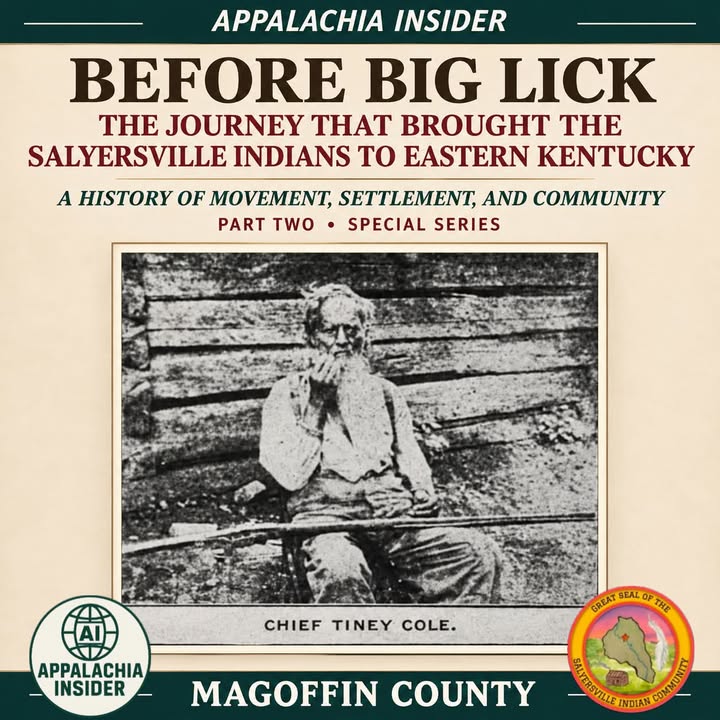
Part Two of an Appalachia Insider Special Series
Long before the Cole, Collins, and Gibson families established their homes in the mountains of Eastern Kentucky, their ancestors were part of a much larger story unfolding across the Appalachian frontier.
It was a story shaped by colonial expansion, broken agreements, changing political boundaries, and the difficult decisions families made in order to preserve their communities.
Today, the descendants of those families form the Salyersville Indian Community, whose historical presence in Magoffin County was formally recognized by the county’s Fiscal Court in June 2026.
But understanding how those families came to settle along Big Lick requires looking considerably farther back, to a time before Kentucky was a state, before the United States existed, and before the mountains of Eastern Kentucky were divided into the counties we recognize today.
Their journey was not a single migration, nor did every ancestral family follow the same path.
Instead, historical records describe generations of movement, settlement, and intermarriage that eventually brought several interconnected families together in the mountains they would come to call home.
THE SAPONI AND COLONIAL VIRGINIA
One of the principal ancestral connections identified in the Salyersville Indian Community’s historical research is to the Saponi, an Indigenous people whose history reaches into colonial Virginia and the surrounding region.
In 1677, the Saponi were among the Indigenous peoples involved in the Treaty of Middle Plantation, an agreement establishing political relationships between Native nations and the English colonial government of Virginia.
These arrangements were complicated and often unequal. Although they recognized certain Native political authorities and established obligations between the parties, the expansion of colonial settlements continued placing pressure on Indigenous communities and their territories.
By the early eighteenth century, the Saponi and several related Indigenous groups, including the Tutelo and Occaneechi, had entered additional agreements with Virginia.
In 1714, Lieutenant Governor Alexander Spotswood established Fort Christanna near the Meherrin River in southern Virginia, where members of these communities gathered under an arrangement intended to provide security and regulate relations with the colony.
The settlement included a school and religious instruction, reflecting colonial efforts to convert Indigenous families to Christianity and introduce English customs.
But the arrangement would not provide lasting stability.
As colonial support weakened and disputes over land and relations with settlers continued, the Indigenous families associated with Fort Christanna gradually dispersed into different communities.
Some traveled north. Others moved south or west, joining related families and establishing new settlements.
One group, described in historical records as Christian Saponi, would become particularly important to the ancestry claimed by the Salyersville Indian Community.
FROM VIRGINIA INTO THE APPALACHIAN FRONTIER
Following the decline of Fort Christanna, a group of Christian Saponi families established themselves along the Rapidan River in Virginia, at a location known as Fox’s Neck.
Historical records from the 1730s identify members of this community, including men bearing the Collins and Bowling surnames.
Those names are important because they appear repeatedly in the historical research tracing the movements of families later associated with the Salyersville Indian Community.
Anthropologist Dr. Richard Allen Carlson Jr., whose dissertation Who’s Your People? examines the community’s ancestry and collective identity, identifies these family relationships as part of a longer connection between the Christian Saponi and the Indigenous families who eventually settled in Eastern Kentucky.
Carlson traces these families through surviving colonial court records, land transactions, and recurring family relationships, examining how their movements and associations connect them to later generations of Indigenous families in Eastern Kentucky.
Nevertheless, the surviving documents provide evidence of Christian Saponi families living in colonial Virginia and of later family groups moving through neighboring regions.
By the middle of the eighteenth century, several Collins and associated families had established residences in Orange County, North Carolina, near the Flat River.
As settlement expanded and political circumstances changed, some moved farther west into the New River Valley along the Virginia and North Carolina border.
There, families associated with the Collins, Bowling, Gibson, and other surnames acquired land, raised children, and established relationships that would continue through subsequent generations.
Their movements took place during an especially unsettled period of American history.
The Revolutionary War altered political authority throughout the colonies, but the conflict did not end the pressures confronting Indigenous families. Questions involving landownership, legal status, racial classification, and relations with surrounding populations continued shaping where and how these communities could live.
For some families, remaining together was as important as remaining in any particular place.
That pattern of maintaining relationships while relocating would become a defining characteristic of the history Carlson documented.
ACROSS THE CUMBERLAND GAP
By the years following the American Revolution, several of these interconnected families had moved into southwestern Virginia and northeastern Tennessee.
Two communities became particularly significant in Carlson’s research: Stone Mountain, in Virginia, and Greasy Rock, near present-day Sneedville, Tennessee.
The settlements included descendants of the Christian Saponi alongside other families who had become connected through residence and marriage.
Among those associated with these communities was Valentine Collins, whose family would become one of the principal ancestral lines of the Salyersville Indian Community.
The Gibson families were also closely associated with these settlements, while members of the Cole family appear in the surrounding historical record.
Carlson’s research identifies John Cole and his wife Cuzzie Anderson Cole as important ancestors of the community’s Cole descendants. Historical testimony places them in North Carolina and later around the Cumberland Gap region, although their precise earlier tribal affiliations remain unconfirmed.
Some later accounts described the Cole family as Cherokee or Catawba. Those claims remain part of the historical record, but the available evidence has not established a definitive genealogical connection to either historical tribe.
What becomes increasingly clear during this period is the relationship among the families themselves.
A marriage between William “Billy” Cole, a son of John and Cuzzie Cole, and Obedience “Biddy” Collins, a daughter of Valentine Collins and Dicy Gibson, connected prominent branches of the families.
Other marriages and shared residences reinforced those relationships.
In time, portions of these families began moving beyond the Cumberland Gap into Eastern Kentucky.
Not everyone made the journey. Some remained in Virginia and Tennessee, where related families and communities continued their own histories.
But among those who moved farther west were members of the Collins, Cole, and Gibson families whose descendants would establish the Salyersville Indian population.
A NEW HOME IN EASTERN KENTUCKY
By 1820, Valentine Collins was recorded in Floyd County, Kentucky, according to census records cited in Carlson’s research.
Other relatives and associated families followed or established residences in surrounding areas during the following decades.
At that time, Floyd County encompassed a much larger territory than it does today. Magoffin County would not be established until 1860, and many of the places that would eventually become central to the Salyersville Indian Community were still identified under earlier county boundaries.
The movement into Eastern Kentucky was gradual.
Families lived in different locations, acquired property, and sometimes moved again before establishing more permanent residences.
By the 1830s, members of the Collins family had acquired land along Jenny’s Creek, in what is now Johnson County.
Other members of the interconnected families were living elsewhere in Floyd County, while relatives continued moving between Kentucky, Virginia, and Tennessee.
During the following decades, the families increasingly established themselves around Middle Creek and its tributaries, including Big Lick, Cole Creek, and Bear Branch.
By the early 1850s, Cole families had purchased adjoining tracts of land in the area that would later become part of the Magoffin and Floyd county border region.
These land purchases were particularly important because they helped establish a geographic center for families whose relationships had been formed over generations and across several states.
The community was no longer defined only by the movement of related families through the Appalachian frontier.
It was becoming a settled population, with homes, property, marriages, children, and an increasingly identifiable place within the mountains of Eastern Kentucky.
And while the precise origins of every ancestral line remain subjects of historical research, the documentation of these families becomes considerably more extensive as their settlements developed during the nineteenth century.
Their descendants would eventually appear in federal census records, local political offices, and newspaper accounts identifying them as an Indigenous population living in the Salyersville District.
But those records belong to the next chapter of their story.
THE FOUNDATIONS OF A COMMUNITY
The journey from colonial Virginia to Eastern Kentucky unfolded across generations, through periods of political conflict, changing borders, and repeated migrations.
It also illustrates something that can easily be overlooked when examining history through names and dates alone.
Communities are not defined exclusively by where their members live at any particular moment. They are also shaped by the relationships, responsibilities, and experiences that connect one generation to another.
For the families whose descendants would form the Salyersville Indian Community, those connections survived repeated changes in geography and circumstance.
By the middle of the nineteenth century, the interconnected families had established themselves in an area that would soon become part of Magoffin County.
There, they would build a community that became known locally as the Cole Nation, with its center along Big Lick Branch.
The population would grow, establish institutions, and eventually attract the attention of newspapers far beyond the mountains of Eastern Kentucky.
The families’ earlier travels explain how they came to be here.
What they built after arriving helps explain why their community endured.
In the next installment of this series, Appalachia Insider will examine the historic Big Lick settlement, the people who lived there, and the community that would become known as the Cole Nation.
Part Two of an Appalachia Insider special series examining the history, people, and future of the Salyersville Indian Community.
Sources: Richard Allen Carlson Jr., Who’s Your People? (2003); Carlson, Salyersville Indian Community Concise Written Narrative for Petition for Acknowledgment as an Indian Tribe (2025); Salyersville Indian Community Tribal Government and Historical Archives, A Brief History of the Salyersville Indian Community (2026); historical colonial, census, and land records referenced in those works.
#AppalachiaInsider #SalyersvilleIndianCommunity #MagoffinCounty #EasternKentucky #AppalachianHistory #NativeAmericanHistory #KentuckyHistory #OurHeritage