
OpEd: The following information does not necessarily reflect the views of Appalachia Insider as an organization.
Published by Appalachia Insider · June 27, 2025
This opinion piece was contributed to Appalachia Insider. The views expressed are those of the author and do not necessarily reflect the views of Appalachia Insider.
**Do Blue States Really Subsidize Red States? And Do Taxes Actually Pay for Government Spending?
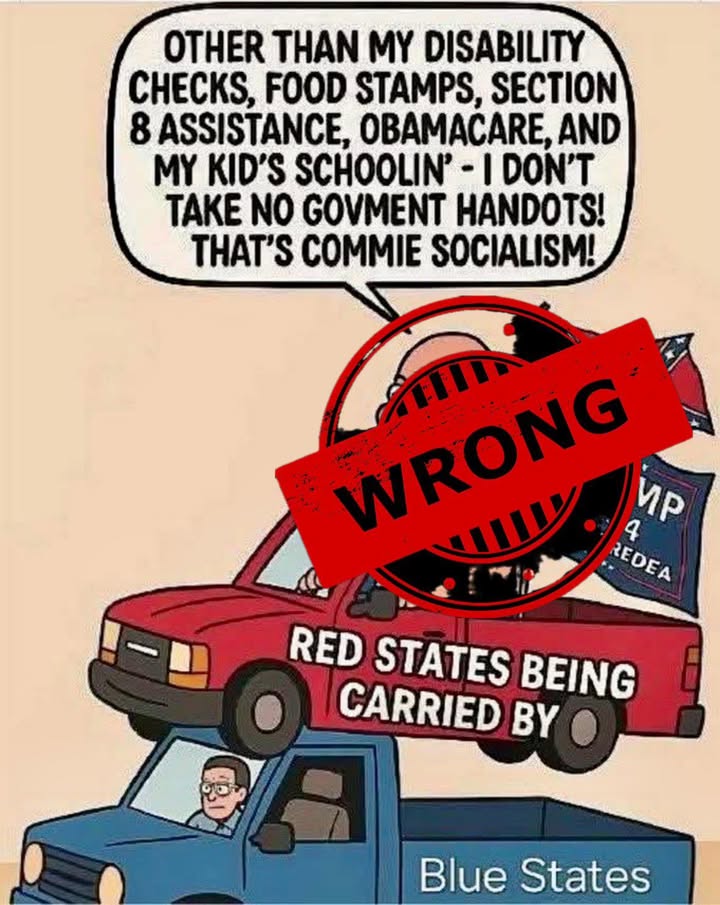
There’s an image that floats around from time to time. A cartoon showing someone in a red-state pickup truck, shouting about “commie socialism,” while listing off every government program they rely on. The truck is being carried by a blue-state taxpayer, who looks exhausted from the weight. It’s meant to be a gotcha. A jab at the idea that some of the loudest voices against government spending are also the ones depending on it.
It’s a clever image. But like most things that go viral, it only scratches the surface. The truth isn’t as simple as the meme makes it out to be. In fact, the reality tells us more about how broken our economic understanding has become. Not just in one part of the country, but across the entire system.
Let’s start with the facts.
Yes, many states that lean red do receive more in federal spending than they pay in federal taxes. That’s not a partisan talking point. It’s a well-documented pattern. States like Mississippi, Kentucky, and West Virginia often receive more in federal investment per person than they send in. On the other side, states like California, New York, and Massachusetts contribute far more than they get back.
So in terms of raw numbers, there is a redistribution happening. But that’s not a moral failing. It’s a design choice. It’s how a national system works.
The deeper question we ought to be asking is this: Does the federal government actually rely on tax dollars to spend in the first place?
And the answer, one that cuts through the noise on both sides, is no. At least, not in the way we’ve been taught.
The federal government isn’t like a household. It doesn’t collect dollars in order to spend them. It creates them. It spends money into the economy first, then taxes some of it back out.
Taxes don’t fund spending. They serve other purposes. They help manage inflation. They influence behavior. They keep the dollar valuable by giving it demand. And they prevent too much money from piling up in too few hands.
So if the federal government can create money, then what’s the point of this whole argument about who pays and who receives?
The point is stewardship.
The issue isn’t that some states receive more. It’s that we’ve stopped asking whether the money is being used well. Not just in red states. In all states.
That’s where Stewardship Economics steps in.
We don’t shame people for needing help. And we don’t punish communities for struggling. But we do expect that public investment leads somewhere. If a state is receiving more in federal resources, the goal is to turn that into opportunity. Better jobs. Stronger wages. Long-term growth. Not to perpetuate the same cycles year after year without asking what’s working and what isn’t.
That’s not about blame. It’s about respect. Respect for the taxpayer. Respect for the recipient. And respect for the idea that every dollar should do something meaningful.
The real problem isn’t the people. It’s the story we’ve all been sold.
We’ve been told that government is broke. That taxes are the only way to afford progress. That some communities are mooching while others are footing the bill.
None of that holds up.
We’ve always had the money. What we’ve lacked is the will to spend it wisely and the courage to ask what we’re getting in return.
So the next time someone shares that image of red states being carried, ask the better question. Not “who’s paying for this,” but “what are we building with it?”
Because the answer isn’t to divide the country. It’s to rebuild it. And that begins with understanding how the system actually works.
~CA