
OpEd-The Doctrine of Misunderstanding: Reagan, Fiat Money, and the Trap We Still Live In
Published by Appalachia Insider · August 20, 2025
This opinion piece was contributed to Appalachia Insider. The views expressed are those of the author and do not necessarily reflect the views of Appalachia Insider.
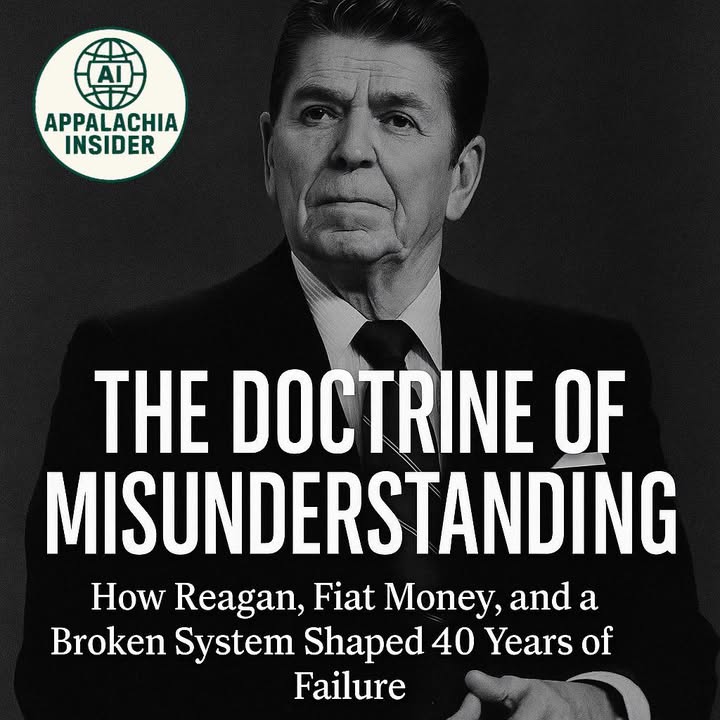
They say Ronald Reagan saved America. The GOP calls him the greatest Republican president of modern times, the man who cut taxes, unleashed the economy, and proved that free markets and small government were the path to prosperity. That is the story they still tell, but the story is not true. Not if you can understand, what he didn’t.
When Reagan took office in 1981, the entire foundation of our economy had already shifted. In 1971, Nixon severed the dollar from gold and turned the United States into a full fiat currency issuer. That changed everything. From that moment forward, the federal government was no longer bound by the same rules as households, businesses, or even states. It could never run out of dollars because it was the source of them. The constraint was not money. The constraint was real resources and inflation.
And here is the tragedy. Washington understood just enough about this new system to be dangerous. They realized they could create money without the old gold standard limits, and they took full advantage of it. But they did not understand what they were breaking in the process. They opened the floodgates, injecting dollars into the economy at levels never seen before, believing they had found a shortcut to endless growth. What they ignored was the other half of the equation.
In a fiat world, taxation is not about paying for spending. It is the system’s stabilizer. It disciplines the flow of dollars, pulls excess liquidity out where it piles up, and recirculates resources where they are actually needed. Reagan and his advisers never grasped this. In fact, they tore the stabilizer out. They gutted progressive taxes. They deregulated financial markets. They dismantled the very withdrawal mechanism the system depends on to stay balanced.
And that decision may have been one of the most economically disastrous outcomes in modern American history. What we were left with was the power to create money without any real understanding of the responsibilities that come with it. We gained the ability to open the floodgates but dismantled the dams and levees designed to manage the current. We built a system where money rushes in at the top and stays there, where speculation replaces production, and where workers fight for scraps while capital piles into stagnant wealth.
By the time Reagan left office, the total supply of dollars in the private economy had nearly tripled. Washington calls it “the national debt,” but that word is misleading. It is not debt the way a household carries debt. It is the record of every untaxed dollar the government has spent into existence. When Congress spends, it creates money. When it taxes, it pulls money back out. What we call “debt” is simply the net balance of what remains in the economy.
And this is the part people need to understand. If we say the United States has $37 trillion in “debt” today, what that actually means is there are $37 trillion dollars sitting out in the private economy. The problem is not the size of that number. The problem is where those dollars are going. Because we dismantled the stabilizers, the vast majority of that money has pooled at the top, locked away in stagnant wealth instead of moving through productive circulation. Reagan’s policies didn’t just inject trillions into the economy. They stripped away the tools needed to guide where the dollars flow. And his own people admitted they did not fully understand what they were doing. David Stockman, Reagan’s budget director, later confessed the administration was “flying blind.” He said, “None of us really understands what’s going on with all these numbers.” That was not an attack from the outside. That was one of the architects of Reaganomics admitting the entire doctrine was built on faith, not comprehension.
And then we locked ourselves into forty years of politicians arguing over the wrong problems. We have spent decades fighting about deficits, without realizing that deficits are not holes in the budget at all. They are the very dollars circulating in the private economy. We have fought over endless rounds of tax cuts for the wealthy, without understanding that in a fiat system stripped of its stabilizers, the wealthy do not simply have the opportunity to become richer. The system makes it unavoidable. The more you cut their taxes, the more dollars pool at the top, clogging the economy with excess money and starving the base of circulation. The river slowed to a trickle where ordinary people live, not because the water isn’t there, but because we built a system with no plan for flow.
Reagan looked like a success. GDP grew. Stock markets soared. Inflation cooled. He became a conservative icon and the patron saint of tax cuts. But most of that was smoke and mirrors. Inflation was already breaking when he took office thanks to Paul Volcker’s brutal rate hikes under Carter. The so-called miracle had already started before he arrived. And while the surface looked stable, underneath it the foundation was cracking. Wages for working families flatlined, inequality surged, and the tax base was gutted. We began the long march into financialization, outsourcing, and hollowed-out domestic capacity.
What Reagan really left us with was not prosperity, but a trap. He turned an economic misunderstanding into a doctrine. He taught Republicans to worship tax cuts and fear deficits. He taught Democrats to accept that framing instead of challenging it. He convinced almost everyone in Washington that the federal budget works like a household checkbook, when in reality the rules are completely different. Forty years later, both parties still fight over spending like we are bound by limits that do not exist.
And that is why we are stuck. We inject trillions into the economy every time there is a crisis, but we have no stewardship. We do not guide the money where it is needed. We do not discipline its flow. We do not build productive capacity at home. Instead, we let it pool at the top, where it does the least good for the people who actually keep this country running. And if we keep doing this, we are headed for collapse. Not because we will “run out of money,” but because we are running out of balance. A fiat system without discipline eventually eats itself alive.
This is not about Reagan the man. It is about the mistake Reagan embodied. He used the keys to the kingdom without understanding how the engine worked, and we have been trapped in that misunderstanding ever since. Until we correct it, nothing else will change.
~CA
OpEd: The preceding information does not necessarily reflect the views of Appalachia Insider as an organization.