
The Illusion of Prosperity: How Clinton Sold the Factory Floor for Paper
Published by Appalachia Insider · August 21, 2025
This opinion piece was contributed to Appalachia Insider. The views expressed are those of the author and do not necessarily reflect the views of Appalachia Insider.
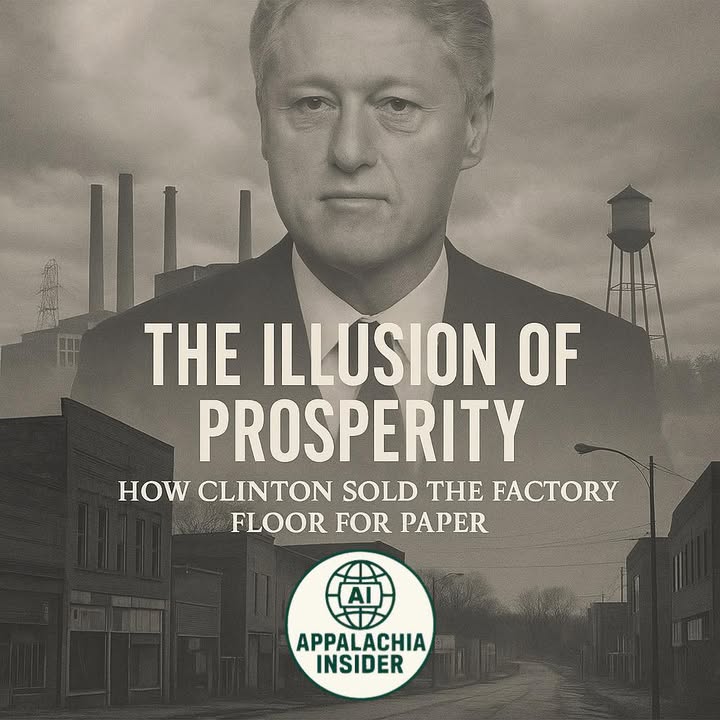
Bill Clinton liked to talk about balance sheets, about prosperity, about the “New Economy.” He sold himself as the man who brought discipline to Washington, a president who turned deficits into surpluses and left America’s finances looking healthy on paper. But behind the numbers, the real foundation was being gutted. Clinton didn’t understand the system he inherited. Almost no one in Washington did.
By the mid-1990s, we were already operating under a fiat currency system, where the federal government was no longer constrained by the gold standard and could create dollars as needed. But they treated it like the old world, as if we still had to scrape and save to pay the bills. They believed the goal was to get the federal books to “balance,” not realizing that every dollar the government “cuts” is a dollar pulled out of the private economy. They chased surpluses without understanding that surpluses drain the lifeblood out of the very system they’re supposed to strengthen.
And where they chose to pull from mattered. When taxes are drawn from vast pools of idle wealth at the top, the economy can absorb it. But Clinton didn’t do that. He aimed straight at the working and middle class, draining the engine that drives real consumption, small business, and local resilience. When you pull from the middle, you don’t just tighten belts, you choke the economy itself.
But the deeper failure wasn’t just the misunderstanding of taxation. It was the surrender of our productive base. Clinton wanted the numbers on the page to look good, and the fastest way to get them there was to ship the real economy overseas. NAFTA wasn’t just a trade deal. It was an illusion, an accounting trick dressed up as progress, a deal where Washington sold off the factory floor to make the books shine. They told us it would mean “jobs. American jobs, and good-paying American jobs.” What it delivered was gutted towns, shuttered plants, and a generation of Americans left behind.
And here’s the bitter truth: we didn’t even sell it for something scarce. We didn’t trade away our manufacturing power for gold, oil, or irreplaceable resources. We traded it for paper, dollars we can create at will.
That betrayal didn’t stop at NAFTA. Clinton doubled down and helped usher China into the World Trade Organization, handing our corporations access to an endless supply of cheap labor. Our factories didn’t just leave for Mexico; they left for China, where wages were lower, regulations thinner, and profits higher. And all of it was financed in dollars we print ourselves. We built the supply chains that now hold us hostage. We trained the engineers, transferred the technology, and handed over the keys to the very rival that now threatens our economic security.
Once those factories left, the skills left with them. The apprenticeships vanished. The small-town economies built around those jobs collapsed, and in their place we were handed slogans about “free markets” and “global competitiveness.” Washington patted itself on the back for balancing the budget while selling off the country’s ability to sustain itself. The same corporations that pocketed the profits now sit on mountains of cash, while the middle class that funded it all was left holding the empty bag.
Under Stewardship, none of this happens. We would have understood the system we were operating under, that the federal government doesn’t “run out” of money, but it can run out of strength. The real constraint isn’t dollars; it’s capacity, purpose, and discipline. Instead of chasing a surplus to impress economists, Stewardship would have reinvested directly into the American base, into workers, into industry, into the ability to make and build. We would have taxed pools of idle wealth at the top, not drained the spending power of the middle class. We would have used the government’s unique monetary power to strengthen domestic manufacturing, reshore critical industries, and ensure that America’s productive capacity remained here, in the hands of its people.
Because a nation cannot trade its ability to produce for paper that it can create at will and expect to remain strong. And this was just the beginning…
~CA
OpEd: The preceding information does not necessarily reflect the views of Appalachia Insider as an organization.