
-The Machine That Ate Its Maker: When the Economy No Longer Needs Us
Published by Appalachia Insider · October 11, 2025
This opinion piece was contributed to Appalachia Insider. The views expressed are those of the author and do not necessarily reflect the views of Appalachia Insider.
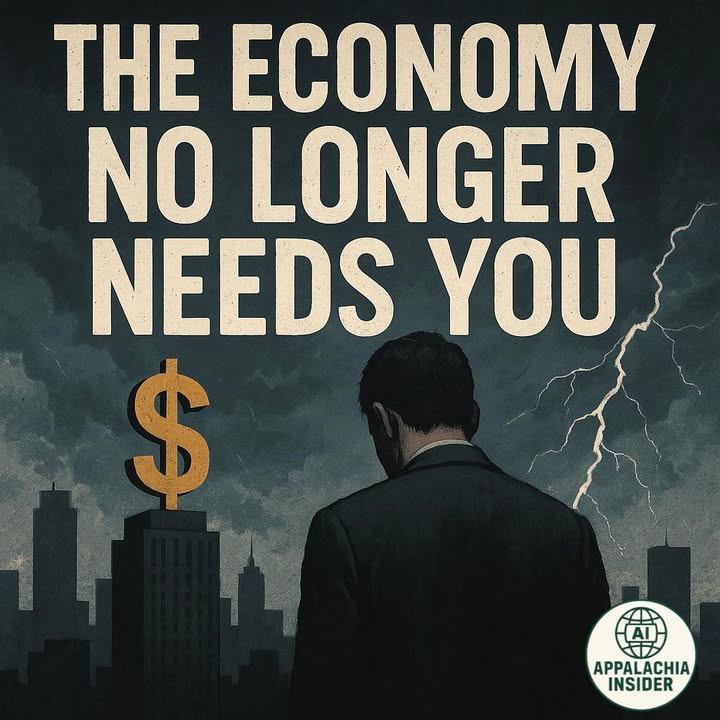
There is a new kind of fear taking shape in America. It is quiet, unspoken, and hard to name. It is not the fear of losing a job, or even of falling behind. It is the fear of no longer mattering, of being economically unnecessary.
For most of human history, the survival of a nation depended on its people. Farmers grew the food. Builders raised the homes. Laborers mined the coal, forged the steel, and laid the roads. The economy was a mirror of the citizenry. If the people struggled, the system did too. But something fundamental has changed. For the first time in history, the machine keeps running whether we are in it or not.
The stock market climbs, profits rise, GDP expands, and yet half the country cannot afford rent or a medical bill. How can the patient be dying while the chart says recovery?
The answer, as strange as it sounds, is that the economy no longer needs its citizens to grow.
That was the quiet warning buried in a government report last quarter. Even as wages stagnated and debt soared, America’s GDP jumped 3.8 percent. On paper, that looked like strength. But a closer look revealed that imports had crashed, consumer spending was flat, and real household participation in the market had actually shrunk. The growth came not from people buying and building, but from financial adjustments and high-end investment.
The truth is brutal. The top ten percent of Americans now drive roughly half of all consumer spending. The bottom sixty percent, the majority, barely move the needle. You and I have become a blip on the chart. The market could lose us and barely feel it.
I want to stress this. If every American outside the top ten percent stopped buying today, the data would barely flinch. The markets might wobble for a week, the graphs might dip, but by the next quarter the machine would smooth it out as if nothing happened. That is how small our share of demand has become.
This did not happen by accident. It began decades ago when men like Milton Friedman taught that the purpose of business was to maximize shareholder value, not serve society. That creed turned the marketplace from a living network into a scoreboard. Then came Alan Greenspan, who spent his career protecting that scoreboard from ever crashing. Every time speculation overheated, the Federal Reserve stepped in to keep the gamblers whole.
What began as capitalism turned into capital preservation.
By the 2000s, Citigroup finally said the quiet part out loud in a private memo to its investors. They called it the Plutonomy Report. In their words, the United States had become an economy powered by and largely consumed by the wealthy few. The rest of the population, they said, now accounted for surprisingly small bites of the national pie.
It was not a theory. It was a business plan.
Once you understand that, everything around you starts to make sense. Wages stagnate because labor is no longer essential to growth. Prices rise because scarcity is more profitable than abundance. Communities decline because they no longer anchor investment. Only return on investment does.
This is what it means to be irrelevant in a market system. The economy does not collapse without you. It simply stops counting you.
That is why the usual political arguments feel so hollow. One side promises to grow the economy, as if growth alone will fix meaning. The other side promises redistribution, as if money without purpose can rebuild dignity. But neither confronts the core truth. We have built an economic order that measures motion instead of life. It can spin forever while people fade from its purpose.
And when citizens no longer power the economy, they stop steering the nation. Democracy itself becomes ornamental. The wealthy do not need to control votes when they can buy outcomes directly. The state becomes an asset manager for the few instead of a steward for the many.
So yes, it is terrifying. For the first time, the market has evolved beyond us. It can grow without human hands. It can rise while families fall. It does not need your paycheck, your purchase, or your permission.
But even now, there are things it cannot buy. It still depends on functioning communities, on people who keep the lights on and the water running, who still show up because they remember what holds the world together. It still depends on the quiet resilience of those who feed, teach, and build.
If we want to matter again, we cannot wait for permission. We have to rebuild an economy that needs people to exist. That starts by making the real indispensable again.
We can begin where the market has no substitute: in food, shelter, energy, care, and skill. Every county that feeds itself is one layer safer from collapse. Every cooperative, workshop, and credit union that keeps money circulating among neighbors is a small act of economic independence. Every teacher who trains young people to fix, grow, or build is preserving the one thing the market cannot automate: competence.
But Stewardship must also be moral. It is not enough to create jobs. We have to create belonging. The goal is not efficiency but resilience, not growth but purpose. A strong people are worth more than a strong quarterly report.
Policy can help, but culture must lead. Local governments can use federal dollars to build things that last, not chase outside investors who strip them bare. Communities can treat infrastructure as inheritance instead of expense. Households can measure wealth in stability, not status. These choices seem small, but together they shift gravity. The machine loses power when the world beneath it starts working again.
So how do we force Washington to fix this?
We start by rebuilding local leverage. The only power Washington respects is scale, and the only scale the public still controls is local. Counties, municipalities, and state compacts are where this begins. If a region can prove that it can use federal funds to create real jobs, local production, and lasting results, it embarrasses Washington into imitation. The government follows success. It always has.
Next, we build a political middle class of mayors, judges, and county executives who speak the same language of Stewardship. Senators and presidents follow when the ground beneath them shifts. A coalition of regional leaders who agree on one thing, to keep capital circulating locally, would shake the national order more than any protest or campaign.
We must also demand transparency of ownership. The people cannot fight what they cannot see. Congress will not reform wealth concentration until it is exposed, and that means making clear who owns the farmland, the housing stock, and the public utilities that once belonged to everyone. Once Americans see how few hands control what sustains them, the pressure to act becomes unstoppable.
Then, Washington must be forced to use its sovereign money power for real investment, not speculation. If the federal government can print to save banks, it can print to rebuild towns. Dollars should flow toward production, infrastructure, and domestic renewal, not asset bubbles and foreign holdings. That is not radical. It is the original promise of a sovereign nation.
Finally, we have to change the language of politics itself. Anger alone will not move a system built to absorb outrage. Only moral clarity and practical performance can. When voters demand outcomes instead of ideology, the system will follow the votes.
Washington will not fix this because we ask nicely. It will fix it because we make competence contagious. When local success spreads faster than national neglect, the capital starts flowing differently.
But I want to be clear. This is not just a policy debate. It is an existential crisis. The nation has quietly crossed a line where the economy can rise without its people. Washington knows it. The markets know it. They have accepted it as the new normal, and in some ways they are even building toward it. They are designing a future that does not require us.
That is what makes this moment so dangerous. Once a society believes it can function without its citizens, it starts treating them as obstacles instead of partners. Every bailout, every consolidation, every rule written for the largest and loudest confirms the same conclusion: the people have become expendable.
It is a sad thing that we have come to a state where we must prove our own relevance to the world we built. As though the creator must stand before its creation, pleading not to be forgotten. What we built to serve us has learned to live without us, and in doing so, has begun to forget why it was made at all.
We are standing on the edge of becoming irrelevant. And if we do not act soon, we will lose the ability to act at all.
Relevance cannot be begged for. It must be reclaimed. We have to rebuild the parts of life that prove we are still needed. We must feed, power, and educate our own communities. We must protect what is local until it becomes strong enough to matter nationally. We must make ourselves impossible to ignore again.
Because once a nation forgets its people, it begins to die from the inside. The lights will stay on, the numbers will rise, the charts will glow green, but the soul will be gone.
This is our generation’s line in the sand. Either we recover the meaning of work, worth, and belonging, or we become ghosts haunting an economy that no longer knows our names.
No machine can remember what it was made for. Only its maker can.
~CA
OpEd: The preceding information does not necessarily reflect the views of Appalachia Insider as an organization.
#economy #AppalachiaInsider #OpEd #government #stockmarket #stockmarketnews