-You Can’t Call Yourself Essential Infrastructure While Telling People to Freeze
Published by Appalachia Insider · January 26, 2026
This opinion piece was contributed to Appalachia Insider. The views expressed are those of the author and do not necessarily reflect the views of Appalachia Insider.
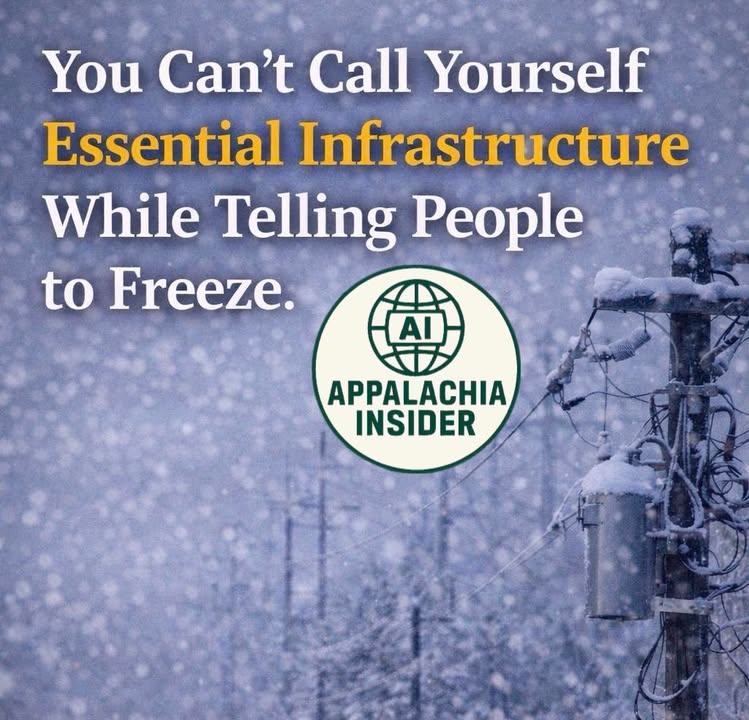
It takes a special kind of nerve for a government-backed monopoly to look at an ice-covered state and tell families to “conserve” heat.
While roads freeze, pipes burst, and homes struggle to stay warm, the institutions granted monopoly power to guarantee reliability step forward with advice instead of capacity. Not preparation. Not assurance. Just instructions for people to endure more discomfort.
Let that sink in.
This isn’t a private company in a competitive market. This is a protected utility. Shielded from competition by the state so it can deliver dependable service when conditions are hardest.
And when the moment arrives, the answer is: bundle up.
That’s not resilience. That’s outsourcing failure to the public.
What makes this worse is the financial structure behind it.
Across the country, many utilities operate under revenue decoupling or similar mechanisms. When customers use less power, rates are adjusted to keep company revenue stable. Conservation doesn’t reduce profits. It just shifts the burden back onto households.
So when monopoly utilities tell families to conserve during an emergency, they aren’t sharing sacrifice. They’re managing public behavior while their own revenue remains protected.
That flips the relationship upside down.
We didn’t accept monopoly utilities so they could manage scarcity by asking people to shiver. We accepted them so they would plan, invest, and build systems capable of handling predictable stress. Winter cold isn’t a surprise. Peak demand isn’t a mystery. It happens every year.
Yet instead of hearing about hardened infrastructure or expanded capacity, we’re handed conservation tips like the public is the one that failed to prepare.
The public provides guaranteed customers, regulated returns, and political protection. In exchange, we’re supposed to receive dependable service. Not conditional service. Not service that depends on whether families can afford to lower their heat without risking their health.
And then it gets wrapped in polite language.
“Do your part.”
“Help reduce strain.”
“Wear extra layers.”
That’s not partnership. That’s deflection.
It normalizes the idea that everyday people should adapt downward while protected institutions remain insulated.
This isn’t about being unreasonable. It’s about expectations.
If a company is granted monopoly status in the name of public service, then public service has to mean something. It has to show up when conditions are worst, not retreat behind press releases and energy-saving checklists.
Because once people realize monopoly protection doesn’t guarantee performance, trust collapses fast.
And when trust collapses, so does the legitimacy of the arrangement.
You can’t call yourself essential infrastructure while telling people to freeze.
That isn’t stewardship.
That’s audacity.
~CA
OpEd: The preceding information does not necessarily reflect the views of Appalachia Insider as an organization.
#AppalachiaInsider #OpEd #KentuckyPower #PowerGrid #EnergyPolicy #UtilityMonopoly #EasternKentucky #WinterStorm #PublicInfrastructure #StewardshipEconomics