
OpEd- The Housing Ladder Is Missing Its First Rung
Published by Appalachia Insider · March 11, 2026
This opinion piece was contributed to Appalachia Insider. The views expressed are those of the author and do not necessarily reflect the views of Appalachia Insider.
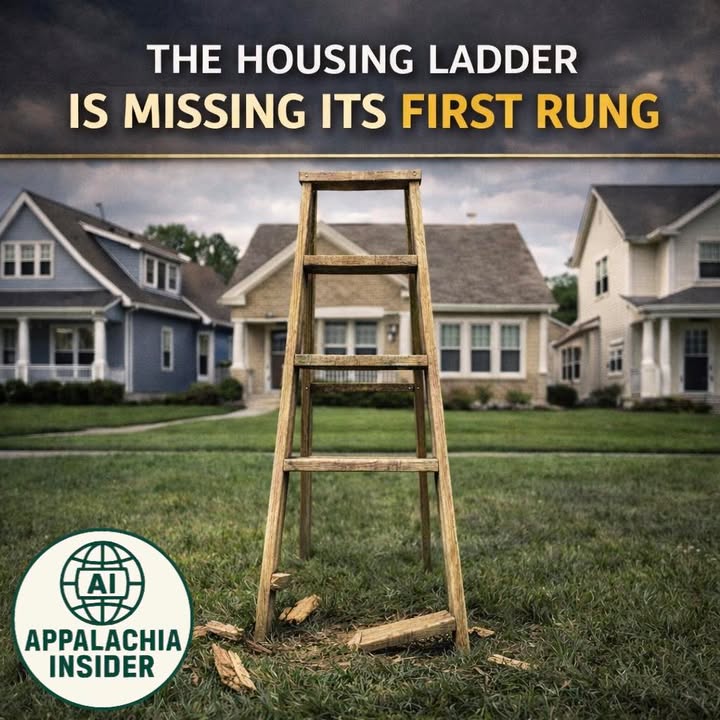
When people talk about housing today, the conversation usually begins in the wrong place.
We argue about prices. We argue about interest rates. We argue about whether young families simply need to work harder or whether retirees should downsize to free up homes.
But a steward begins somewhere else.
A steward asks what a healthy housing system actually looks like.
For most of the last century in America, housing worked like a ladder. A young couple bought a modest starter home. As their family grew and their income improved, they moved into something larger. Later in life, when the children moved out and retirement approached, many downsized again.
Homes circulated.
That circulation was the quiet mechanism that kept the housing system functioning across generations. Each step opened the next step for someone else.
Today, that ladder is breaking.
Starter homes have nearly vanished from the market. Builders rarely construct them anymore, and the reason is simple. The economics do not favor it. Land costs the same whether the house is large or small. Permits cost the same. Infrastructure costs the same. A developer will almost always make more profit building a four-hundred-thousand-dollar home than a one-hundred-sixty-thousand-dollar home on the same lot.
So the market follows the profit.
Larger homes are built. Smaller homes disappear.
The result is that the first rung of the ladder quietly vanishes. Young families searching for their first home find themselves staring at prices that make little sense for the incomes they earn.
When the first rung disappears, the entire ladder begins to fail.
Most policy debates approach this problem from two directions. Some argue the solution is removing regulations so developers can build more housing. Others argue for subsidies to help people afford the housing that already exists.
Both approaches recognize part of the problem.
But neither addresses the structural gap that has emerged.
The private market is not ignoring starter homes out of malice. It is following the incentives placed before it. When larger homes generate larger profits, that is what gets built.
Stewardship approaches the issue differently.
Stewardship asks whether the systems we rely on are still functioning well enough that the next generation will inherit a society that works.
In the case of housing, the system is no longer functioning as it once did. The market has largely abandoned the production of modest starter homes.
When a critical piece of infrastructure disappears from the system, a steward recognizes a responsibility to restore it.
Housing is often treated as a consumer product or a financial asset. But it is also infrastructure. It is the foundation that allows families to form, communities to grow, and economic life to function.
When young families cannot access housing, the consequences ripple outward through the entire society.
Birth rates fall. Communities age. Economic mobility slows. The future quietly narrows.
Instead of arguing endlessly over the houses that already exist, a steward asks a different question.
Do we have the capacity to build the homes families need?
The United States has answered that question before. During the Great Depression and the years surrounding World War II, the federal government organized massive construction efforts that built roads, bridges, schools, parks, dams, and public buildings across the country. Programs like the Works Progress Administration did not merely provide temporary jobs. They created infrastructure that communities still depend on nearly a century later.
Housing could be approached with the same spirit.
A national effort such as a Steward’s Housing Works Program could focus specifically on rebuilding the first rung of the housing ladder. Instead of luxury developments or high-rise public housing, the emphasis would be on modest, durable homes built for working families. Houses between nine hundred and fourteen hundred square feet. Streets where children can ride bicycles. Yards where families can plant gardens.
Homes designed to be lived in rather than traded like financial assets.
These homes would not be permanent government housing. They would be offered primarily to first-time buyers and young families at cost or through long-term lease-to-own arrangements. Once purchased, they would enter the normal housing market like any other home.
The program would not replace the private housing market.
It would restore the missing foundation that allows the rest of the market to function.
At the same time, such an effort could rebuild something else the country has been quietly losing.
Its ability to build.
A national housing effort would require electricians, plumbers, carpenters, masons, equipment operators, and surveyors. Apprenticeship programs could train young workers while construction is underway, creating a new generation of skilled tradesmen whose abilities would serve the nation for decades.
The program would not simply produce houses.
It would produce the people capable of building the future.
Whenever ideas like this are discussed, the same question inevitably appears.
How do we pay for it?
It sounds like a practical concern, but the question assumes something that is not actually true in a sovereign currency system.
The federal government does not collect dollars before it spends them. It creates the currency. Every dollar circulating through the economy exists because the government spent it into existence before anyone else could earn it.
That means the real constraints on a national housing effort are not financial.
The real limits are physical.
Do we have the workers?
Do we have the materials?
Do we have the land?
Do we have the energy and logistics required to build?
If those resources exist, then the nation already has the capacity to build homes. The dollars required to mobilize them are simply the accounting tool used to organize the work.
Stewardship measures success by whether the systems a society depends on continue to function across generations.
A society that finds itself fighting over the houses that already exist may be asking the wrong question.
The better question is simpler.
If families need homes, and the nation has the land, the materials, and the workers capable of building them, why would we spend our time arguing over scarcity instead of building the first rung of the ladder again?
Somewhere tonight a young couple is scrolling through listings, wondering if there will ever be a place they can afford to raise their children.
Stewardship begins with a simple recognition.
When the first rung of the ladder disappears, it isn’t enough to argue about who deserves the remaining steps.
Someone has to build the ladder again.
~CA
OpEd: The preceding information does not necessarily reflect the views of Appalachia Insider as an organization.
#AppalachiaInsider #EasternKentucky #HousingCrisis #StewardshipEconomics #FirstTimeHomebuyers #Appalachia