
OpEd- The Pragmatic Path in Local Government
Published by Appalachia Insider · April 6, 2026
This opinion piece was contributed to Appalachia Insider. The views expressed are those of the author and do not necessarily reflect the views of Appalachia Insider.
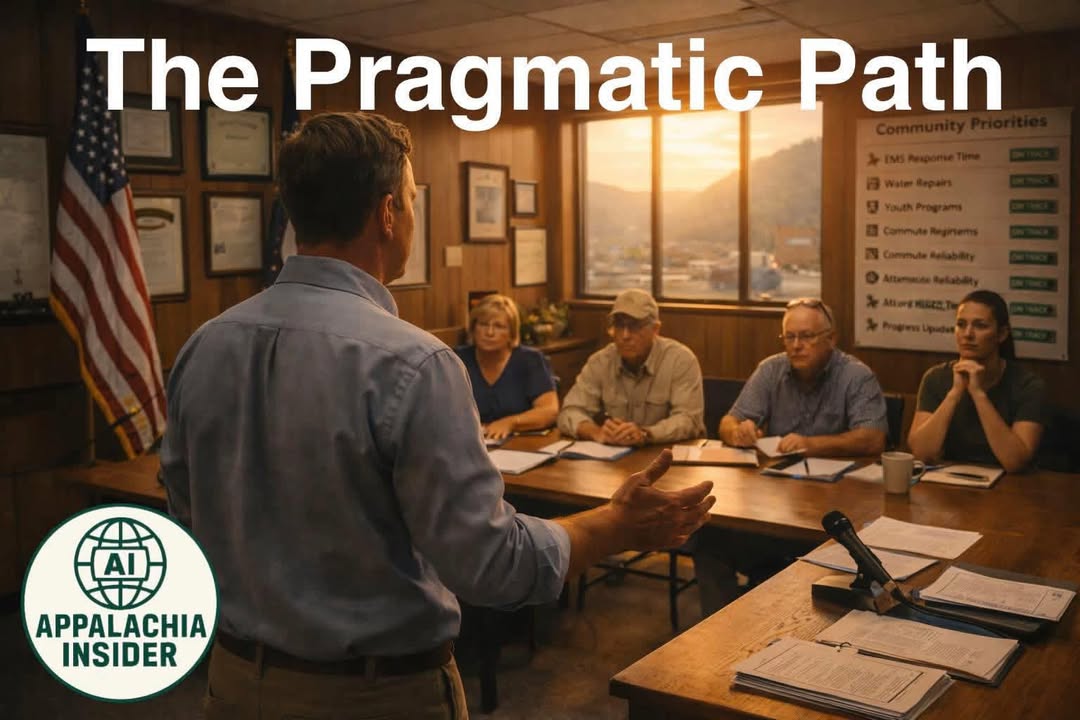
Most people think government happens somewhere far above them, in rooms they will never enter. But a county rises or falls in the quiet and ordinary systems that shape daily life. The road that survives the winter. The water that runs clean. The ambulance that arrives in time. The school that steadies a child. These things are not theories. They are the bones of a community. And if the Pragmatic Path means anything, it must mean something in places like Magoffin, where the cost of failure is carried by people who have no safe exit.
For years, counties have been told to measure themselves by compliance. If the forms are filled, the grant is submitted, and the budget balances on paper, then someone somewhere declares the county functional. But Magoffin is not living inside that illusion. Too often the forms are not filled, the grants are not submitted, and the budget balances only in the narrowest technical sense. What should be a working operating system has become a set of habits held together by the last person in the room who still feels responsible.
This is not written in contempt. It is written because nothing can be rebuilt unless we are honest about what is broken.
The Pragmatic Path begins with three questions that most local governments never bother to ask. Are our people happier than they were last year. Are they more stable. Do they have more purpose in their daily lives. If the answer is no, then nothing else matters. Not the paperwork. Not the speeches. Not the politics. Outcomes come first.
But sunlight does not bring peace in the beginning. It brings resistance. It threatens the people who have learned how to operate in the dark. The early months are not about applause. They are about endurance. Rumors move faster than facts. Old friendships strain. People who praise accountability in public turn against it in private. Transparency does not create enemies. It reveals them.
Anyone brave enough to walk this path must be ready for that. The first victory is survival. If you can hold steady long enough, the public eventually sees what the light reveals.
To move forward, the county needs a center of gravity. Someone, or some small office, that gathers the truth rather than letting it scatter. This is what I call a Stewardship Office. It is not another layer of government. It is simply a steady hand that keeps the county pointed in one direction. But even that small step runs into the first hard reality in a place like Magoffin. The people with the skills to run such an office have often left. Others are stretched across several jobs. Rural reform usually fails not because the ideas are flawed, but because the people required to carry them do not exist in the numbers a county needs.
So the county must recruit someone home, borrow expertise for a time, or grow someone from within. They do not need a degree in government. They need follow through, steadiness, and a backbone. Competence is not optional. It is the soil every reform grows from.
Once that person exists, the work begins with gathering whatever truth can be found. Not perfect records. Not neat spreadsheets. Just the facts in whatever shape they exist today. Magoffin does not have the recent data a modern county should have, so the baseline must be built while the house is still burning. Thirty days of EMS timestamps. A handwritten log of water breaks beginning now. A resident reporting line that turns frustration into information. Two years of school attendance trends. The baseline does not have to be pretty. It only has to be real.
Departments then begin meeting together in a way they have not done for years. Not to guard turf or defend habits, but to explain how their work shapes the daily lives of the people they serve. When the language shifts from outputs to outcomes, the culture begins to shift with it.
But Magoffin is not a single organization. It is a loose collection of authorities. The school board is elected. The ambulance district stands apart. The medical facility answers to its own leadership. Fire departments each have their own structure. The judge does not control all of this, and the magistrates do not either.
So the Stewardship Office must win through clarity rather than control. It must become the table everyone returns to because the measurements matter more than jurisdiction. If a district refuses to cooperate, the county measures anyway. If a partner agency drifts, the public sees the drift. Daylight becomes quiet leverage. Real transparency does not hide in a courthouse filing cabinet. It lives where the people live. Every scorecard update, every project milestone, every delay or correction is posted on the county’s social media pages in plain language so anyone with a phone can see it. Accountability means nothing unless ordinary people can watch the work unfold in real time.
Money must be named honestly. A Stewardship Office is not free. It will cost enough to attract someone who can actually do the work. But as I have written many times, the county is not short of money. It is short of alignment. It is short of discipline. Tens of millions move through Magoffin every year and leak out as fast as they arrive. Creating a single position that pulls the county in one direction is not a burden. It is a correction. If we cannot redirect a small fraction of what already passes through our hands, then we do not have a revenue problem. We have a priorities problem.
Even so, none of this survives if the fiscal court decides to kill it. In Kentucky, a single magistrate with a grudge can end the reform in one meeting. The judge can bury it by refusing to place it on the agenda. This is why the path must begin with the people rather than the courthouse. The public has to understand the new language of outcomes. They must see early wins that touch their daily lives. Once people begin to see clearly, the political gravity shifts.
And even then, in some counties, reform only arrives when time removes the old guard. Some leaders are not persuaded. They retire out or age out. Rural politics has its own pace, and sometimes daylight works slowly.
This is why the three core metrics must sharpen into numbers nobody can deny. Happiness measured by a twice yearly life satisfaction question and by whether young adults are leaving or staying. Stability measured by EMS response times, water advisories, commute reliability, and the number of households who cannot weather a small emergency. Purpose measured by volunteer participation, youth engagement, local business survival, and adult skill building.
Simple. Understandable. Hard to fake.
These become windows the public can look through. And windows change everything.
But none of this matters unless the county survives the first year. That year is the crucible. It is where sabotage is quiet. It is where praise on Monday becomes a complaint on Friday. It is where the habits of the past pull like gravity.
You survive it through steadiness, transparency, small visible wins, and a leader who absorbs blows without striking back. A leader who understands that the path wins through consistency rather than argument.
And there is one final truth. These words only matter if they come from someone rooted here. Someone who stayed. Someone whose people are buried in this soil. Someone who carries the memory of this place in their bones. If the wrong person speaks these truths, they sound like lecture. If the right person speaks them, they sound like home.
A county that embraces the Pragmatic Path does not become perfect. It becomes honest. It becomes intentional. It becomes capable of building again. It becomes a place where people believe that tomorrow is not a fate handed down, but something they can shape together.
When that happens, the county begins to rise. Not by accident. Not by miracle. But by choosing to see clearly, to speak plainly, and to build without fear.
~CA
OpEd: The preceding information does not necessarily reflect the views of Appalachia Insider as an organization.
#PragmaticPath #StewardshipEconomics
#LocalGovernment #EasternKentucky
#MagoffinCounty #AccountabilityMatters
#AppalachiaInsider