
OpEd- A Place to Hold the Line: A Stewardship Plan for Emergency Stabilization in Magoffin County
Published by Appalachia Insider · April 8, 2026
This opinion piece was contributed to Appalachia Insider. The views expressed are those of the author and do not necessarily reflect the views of Appalachia Insider.
In Magoffin County, when something serious happens, there’s a moment that settles in before help arrives.
It’s quiet, but it’s heavy.
You’re watching someone struggle to breathe. Or you’re holding pressure on a wound. Or you’re waiting on headlights that feel like they’re taking too long to appear. And in that moment, you realize something most people never have to think about.
Distance is not measured in miles.
It’s measured in time you may not have.
So the instinct is to say we need a hospital.
But a steward doesn’t begin with instinct. A steward begins with reality.
Magoffin County does not have the population to sustain a full hospital. Not financially, not operationally, not consistently. And pretending otherwise doesn’t build anything. It just repeats the same cycle of failure rural communities have already lived through.
So the question isn’t how to build a hospital. The question is what problem we are actually trying to solve.
And the answer is simple.
We are trying to keep people alive long enough to reach definitive care.
That is a different mission. And when you define it that way, a different kind of solution becomes possible. Not a hospital, not an emergency room, but something far more focused.
A place to hold the line.
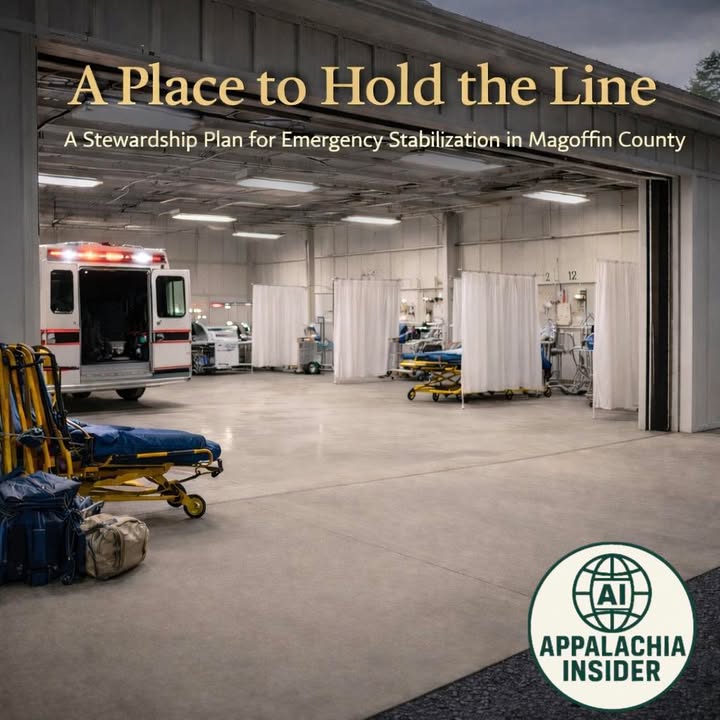
Magoffin County needs a Nonprofit Emergency Stabilization Center. A locally governed, community-supported facility designed for rapid triage, immediate stabilization, and coordinated transfer. No admissions, no inpatient beds, no long-term care. Just the critical window between crisis and survival.
There’s a natural objection to this. People will say, “That’s what the ambulance is for.”
But that only sounds right until you look at what an ambulance actually is.
An ambulance is a mobile response unit. It is built to reach you, begin care, and move. It is not built to hold patients, manage multiple cases at once, or stay in one place. When an ambulance leaves the county on a long transport, it leaves the county exposed.
So the system we have today forces a trade-off.
Stabilize longer and delay transport, or move quickly and risk deterioration on the road.
Either way, something is being sacrificed.
A stabilization center removes that trade-off. It gives EMS a place to transfer care immediately and return to service, while stabilization continues without interruption. It increases coverage, not just capability.
It does not replace the ambulance.
It makes the ambulance viable.
Inside, the design is simple. A small number of treatment bays, cardiac monitoring, airway support, bleeding control, essential medications, telemedicine physician support, and direct EMS integration. Nothing more than what is needed, and nothing less.
Because under the Stewardship model, we don’t build systems for what they claim to be. We build them for what they actually do. And in rural America, emergency care is not about procedures.
It is about time.
The next objection will be regulatory. People will say this triggers Kentucky’s Certificate of Need, that it will be blocked before it begins.
That argument only holds if this is a hospital.
It is not.
Kentucky’s Certificate of Need applies to institutional healthcare facilities like hospitals, freestanding emergency departments, and certain outpatient centers that admit patients, expand services, or compete directly with existing providers. This center does none of those things. It does not admit, it does not operate as an emergency department, and it does not duplicate hospital services.
It stabilizes and transfers.
That places it within the operational scope of Emergency Medical Services, which are regulated separately as response systems, not institutional facilities. This is not an attempt to bypass the law.
It is an alignment with it.
Call it what it is, and structure it correctly, and Certificate of Need is not triggered. Call it something it is not, and it will be stopped immediately.
That distinction is the difference between failure and success.
The final objection is cost. And this is where most rural ideas collapse, because they are built on the wrong funding model.
Hospitals require volume, admissions, billing, and constant throughput. They are expensive because they are designed to be everything at once.
This center is not.
It does not admit patients, operate surgical services, require full hospital staffing, or carry the overhead of a traditional facility. It is smaller, narrower, and because of that, fundamentally less expensive to build and sustain.
More importantly, it is not dependent on volume to survive.
It is a readiness system.
And readiness systems are not funded by how often they are used, but by how critical they are when they are needed.
We already understand this.
We fund fire departments that may not see a structure fire for weeks. We fund EMS systems that must be ready whether the call comes or not. Not because they generate revenue, but because when they are needed, nothing else will do.
This center belongs in that same category.
Funded through a combination of local support, county partnership, targeted grants, and limited appropriate billing, its purpose is not to produce profit. Its purpose is to ensure that when the moment comes, the outcome is not decided by distance alone.
This is what Stewardship demands.
Not building what sounds complete, but building what actually works.
Right now, Magoffin County is being asked to bridge distance with time it does not have.
This plan shortens that distance.
It gives EMS a place to do more than load and go. It gives patients a better chance in the minutes that matter most. It gives the community something it has not had in a long time.
Not a guarantee.
But a chance.
And in moments like the ones that begin in quiet rooms and on the sides of narrow roads, that chance is everything.
~CA
OpEd: The preceding information does not necessarily reflect the views of Appalachia Insider as an organization.
#AppalachiaInsider #MagoffinCounty #EasternKentucky #RuralHealthcare #EMS #EmergencyCare #HealthcareAccess #StewardshipEconomics #ThePragmaticPath #BuildWhatWorks