
OpEd- Coal Ash to Cash: A Stewardship Plan for Kentucky’s Second Chance
Published by Appalachia Insider · April 21, 2026
This opinion piece was contributed to Appalachia Insider. The views expressed are those of the author and do not necessarily reflect the views of Appalachia Insider.
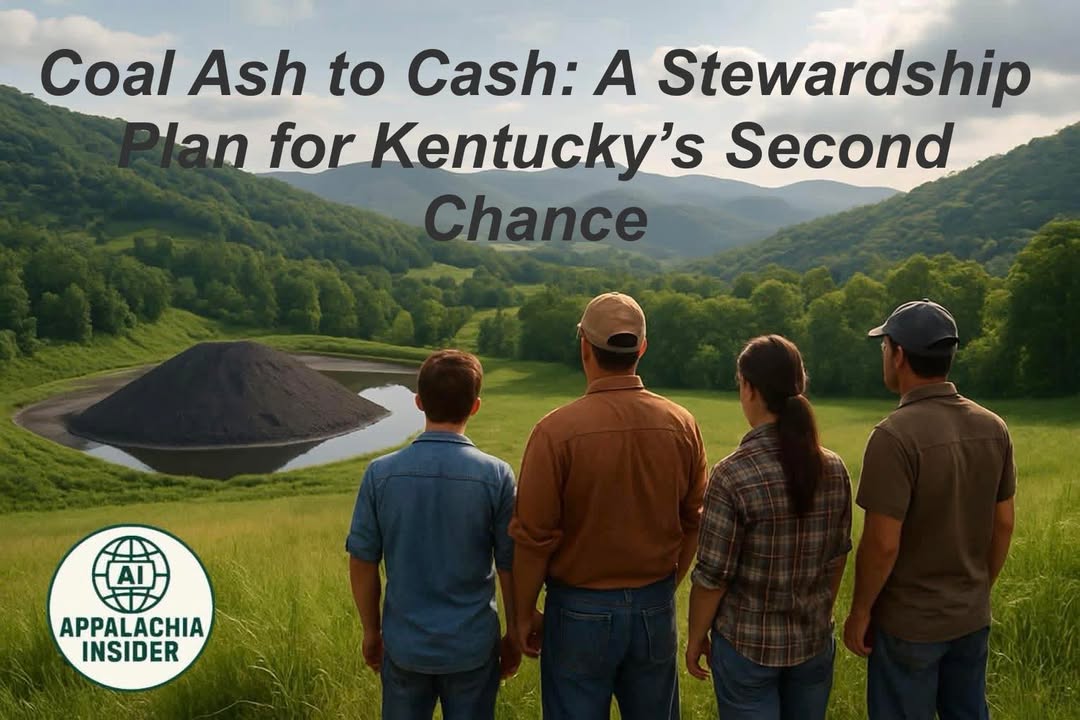
For more than a hundred years, Eastern Kentucky carried America on its back. Our coal lit its homes, powered its factories, and built its wealth. We gave everything. The hills, the rivers, our health, and our people were spent so the rest of the country could grow. When the coal was gone, we were left with the scars.
Now we are standing at another crossroads.
The same coal that once built America left behind something most of us never knew existed. In the gray ash piled up around our power plants and hollers lies something valuable. Rare earth elements.
-The Hidden Value in Kentucky’s Ash
Rare earth elements, or REEs, are not science-fiction metals. They are in nearly everything we touch. They make our smartphones work, our trucks run, and our power grids spin. They are inside the batteries of electric cars, the turbines on modern wind farms, and the guidance systems that defend our country. Without them, the modern economy slows to a crawl.
Here is what matters: our coal ash in Magoffin, Johnson, Floyd, Pike, and across Appalachia is rich in these metals. According to the U.S. Department of Energy and the University of Kentucky’s Center for Applied Energy Research (CAER), Kentucky coal and coal byproducts can contain up to 1,000 parts per million of REEs, particularly in the Fire Clay coal seam that runs beneath much of Eastern Kentucky.
This is not theory. Researchers at CAER, led by Professor Rick Honaker, have already built a pilot-scale plant in Webster County proving these metals can be recovered. Their work has successfully produced rare earth concentrates with 99 percent purity. The technology exists. The value is real.
-The Stakes for Eastern Kentucky
Right now, a company called Ramaco Resources raised $200 million to recover REEs from coal ash in Wyoming. They are racing to build plants and lock down supply chains while Kentucky’s potential remains untouched.
If we do nothing, history will repeat itself. Outsiders will take control, haul away what is valuable, and leave us with the cleanup. We cannot afford to let that happen again.
This time must be different.
Stewardship Economics teaches us one simple truth: the wealth of this place belongs to the people who live here. That means no giving away resources for pennies. No signing away our rights before we understand the value. No deals that send profits to boardrooms hundreds of miles away while our towns stay poor.
To do that, we need a plan.
-Step One: Form the Kentucky Rare Earth Compact
The first step is creating a partnership among the Eastern Kentucky counties where coal ash storage is concentrated. Magoffin, Johnson, Floyd, Pike, Knott, Perry, Letcher, Breathitt, and others share the same resources, the same risks, and the same potential.
Instead of competing for outside investment, we unite behind one principle: Wealth Stays Home.
How it works:
* Each county sends trusted representatives, including a small business owner, a skilled trades leader, an educator, a working parent, and one local official.
* The Compact operates in the open. Meetings are public, priorities are shared, and progress is measured by simple scorecards that every resident can understand.
* Each county gets one vote. No single community dominates the others.
Speaking with one voice gives us bargaining power with the state, federal agencies, and private investors. United, we cannot be picked apart deal by deal.
-Step Two: Launch Local Pilot Projects
We start small and prove the value ourselves.
Partner with UK’s CAER to replicate the success of their Webster County project here in Eastern Kentucky. Apply for existing Department of Energy grants dedicated to rare earth research and recovery.
A pilot-scale extraction project in Magoffin, Johnson, or Pike County would demonstrate what is possible. Locals could see real results, not just promises. When the numbers are proven on paper, trust grows.
-Step Three: Build Local Processing Facilities
The money is not in the dirt. It is in the refining.
If we allow companies to scoop up our ash and ship it to Texas or China, we will repeat the same mistakes we made with coal. The jobs will leave. The wealth will leave. And we will be left behind again.
Instead, every contract must require local processing facilities tied directly to extraction sites. That means:
* Training workers through KCTCS and local vocational schools
* Creating high-paying jobs that stay in Eastern Kentucky
* Reinvesting a fixed percentage of profits into schools, roads, and water systems
When the processing is done here, the value stays here.
-Step Four: Guarantee Community Ownership and Revenue Sharing
Coal left us with broken promises because the ownership was always somewhere else. That cannot happen again.
The Compact locks in agreements that guarantee:
* A percentage of profits reinvested directly into the affected counties
* Cooperative ownership models where residents build equity in the projects
* Community benefit agreements requiring investment in schools, parks, clinics, and infrastructure
Every contract follows one rule: the wealth extracted from Eastern Kentucky stays in Eastern Kentucky.
-Step Five: Stewardship Over Speculation
This is not a gold rush. It is not about flipping assets or chasing a quick payday. Stewardship means using what we have wisely, building slowly, and keeping our priorities straight.
Success is not measured by how fast we extract these metals but by what we build with them. We measure progress by stable families, stronger schools, good jobs, and wealth that circulates here instead of disappearing somewhere else.
-Why This Matters
This is more than an economic opportunity. It is a test of whether Eastern Kentucky has learned from its history.
We can take the ash that poisoned our water and turn it into the fuel that rebuilds our towns. We can train our own workers instead of watching outsiders carry off the best jobs. We can turn a century of loss into a generation of renewal.
This is our second chance. If we waste it, there will not be a third.
This time, the wealth stays home.
~CA
Disclaimer: Originally posted September 2025
OpEd: The preceding information does not necessarily reflect the views of Appalachia Insider as an organization.