
OpEd- A County Earns What It Keeps
Published by Appalachia Insider · April 24, 2026
This opinion piece was contributed to Appalachia Insider. The views expressed are those of the author and do not necessarily reflect the views of Appalachia Insider.
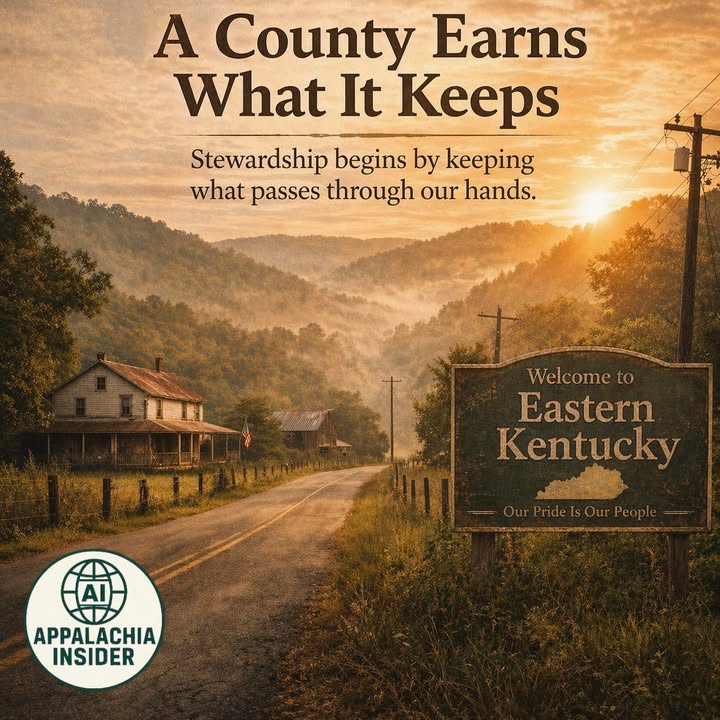
People have spent my whole life calling Eastern Kentucky a poor place. They say it on the news. They say it in Frankfort. They say it every time we show up in a ranking nobody wants to be on. But I have never believed that. And the older I get, the more I realize something most people never see. This region is not poor. This region is leaking.
We receive far more money each year than anyone realizes. Federal programs, Social Security, Medicare, Medicaid, SNAP, school funding, retirement checks, and project dollars all pass through Eastern Kentucky year after year. The problem is not that the money never comes. The problem is that it never stays.
Earning begins with keeping. A dollar that stays builds. A dollar that leaves too quickly never has the chance to belong to us in any lasting way. And because we have not kept, we have not earned. Not in the way that strengthens families or builds a future.
Eastern Kentucky receives billions of dollars each year in federally supported flows. Even a modest retention rate would change the trajectory of this region. Retaining just a fraction of that total would keep tens of millions of dollars circulating locally instead of leaving almost immediately. That alone would represent more economic strength than has been seen here in decades.
This would not require new funding. It would not require higher taxes. It would not depend on bonds or loans. It is money that already passes through this region each year, leaving almost as quickly as it arrives.
The first step is something that should have been done generations ago. A full and honest accounting of every dollar entering Eastern Kentucky. Not estimates. Not assumptions. A complete map of every program, every reimbursement, every grant, and every project that touches this place. What is not measured cannot be corrected. What is not understood cannot be grown.
Once the picture is clear, the truth becomes unavoidable. The problem is not a lack of money. It is the number of exit points that allow that money to leave before it strengthens the region. This is not an argument about personal choice. Families will always make the decisions that best serve their needs. That freedom remains.
But the absence of local options is not a reflection of the people. It is a reflection of what was never built. Spending leaves the region because services, goods, and opportunities are located elsewhere. Labor is imported because local capacity was never developed. Healthcare is sought outside the region because local systems were never established at scale.
Stewardship requires the rebuilding of those options. It requires the creation of a local economy capable of retaining what already flows through it. Where functional alternatives exist, people choose them. Not out of obligation, but because they provide value.
In counties where local markets are connected to programs such as Kentucky Double Dollars, food spending begins to circulate locally. A household’s purchasing power increases. Local producers earn more. Dollars that would otherwise exit the region begin to remain within it. No one is compelled to participate. The system works because it aligns incentives with outcomes.
Applied more broadly, the same principle holds. Incremental improvements in local trades, childcare, healthcare, construction, and services begin to compound. Retention in one area supports retention in another. Over time, the structure of the local economy shifts. This is how durable growth occurs. It does not begin with external investment. It begins with internal retention.
There is a common belief that the solution is to attract outside business. The more immediate priority is to eliminate the conditions that require dependence on it. Stability attracts investment. Strength attracts interest. A region that demonstrates the ability to retain and circulate its own resources becomes a place others seek to join.
Strength is magnetic.
Stability is magnetic.
A region that keeps what it earns becomes a place of interest.
Not because it sought attention.
Not because it offered concessions.
Not because it accepted unfavorable terms.
But because it established value.
External investment should be welcomed only under conditions that reinforce the region. Profit cannot come at the cost of extraction. Any entity that benefits from this place must contribute to its strength. Labor must be compensated fairly. Participation in the local economy must leave measurable value behind.
Failure to enforce this standard is what allowed exploitation to take root across Appalachia. Enforcing it is how that pattern is broken.
There is a principle older than any policy. A man who keeps what he earns is not poor. That same principle applies to a region. Eastern Kentucky has received substantial financial inflows for years. But receipt is not the same as earning. A region earns what it keeps.
Capture what is already here.
Allow it to circulate.
Build from within.
Establish a foundation that others recognize as stable and worth joining.
This is not charity.
This is not theory.
This is responsibility.
It is the recognition of value.
And it is the decision to retain it.
~CA
OpEd: The preceding information does not necessarily reflect the views of Appalachia Insider as an organization.
#AppalachiaInsider #EasternKentucky #OpEd #StewardshipEconomics #EconomicDevelopment #LocalEconomy #RuralAmerica #KeepItLocal #BuildFromWithin