
OpEd- The Steward’s Farm Bill: Restoring the Backbone of American Agriculture
Published by Appalachia Insider · April 27, 2026
This opinion piece was contributed to Appalachia Insider. The views expressed are those of the author and do not necessarily reflect the views of Appalachia Insider.
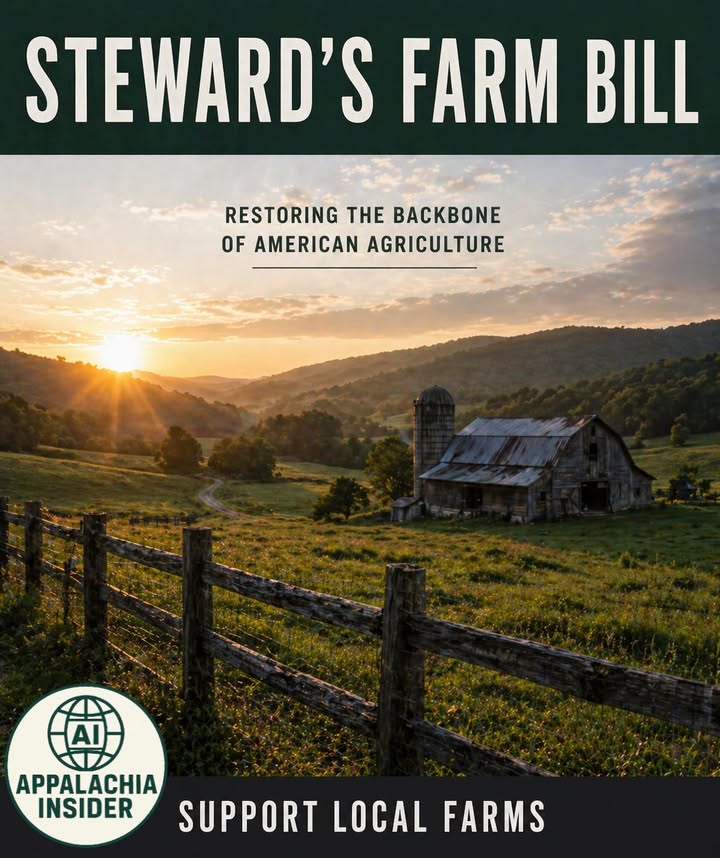
There are still places in this country where the land tells the truth.
You can stand at the edge of a small farm just after sunrise and see it plainly. Rows that don’t stretch for miles, but bend with the shape of the ground. A mix of crops instead of a single color. A barn that has been repaired more times than it has been replaced. And a man or a woman who knows every acre not by number, but by memory.
That farm doesn’t exist because the system favors it. It exists in spite of the system.
For nearly a century, farm bills have funneled billions of dollars into keeping America’s fields producing. But the story of that support has never been one of balance. It has been tilted toward the largest landholders, the most mechanized operations, and the most export-driven crops. We built a structure where a thousand acres of corn grown for ethanol can rely on federal lifelines, while a family farm growing potatoes, beans, and tomatoes for a local school is left to carry the risk alone.
A Steward’s Farm Bill doesn’t shrink the federal role in agriculture. It expands it under new terms. It stops measuring success by how many bushels leave our ports, and starts measuring it by how much nourishment stays in our towns, how many jobs remain rooted in the soil, and how stable our communities become.
It begins with subsidies. The government would no longer write its largest checks to monocrop fields tied to global markets. Support would move toward diversification. If a farmer grows multiple staple crops that Americans actually eat, that work is recognized. If the land is rotated and restored, that effort is rewarded. If acreage is committed to local supply chains, that commitment is supported. The system would stop paying for size and start paying for stewardship.
It continues with procurement. The federal government already feeds millions of people through schools, hospitals, the military, and prisons. A Steward’s Farm Bill would turn that purchasing power inward. A growing share of those meals would come from regional producers. Small and mid-sized farms would gain stable contracts that do not rise and fall with global commodity swings. They would no longer be peripheral to the system. They would be part of its foundation.
It extends to outcomes. We would stop pretending that yield is the only measure that matters. Farmers who rebuild topsoil, protect water, employ local workers, and invest in community processing would be compensated for those outcomes. Not as a side program, but as a central priority. We would pay not just for production, but for preservation.
It recognizes infrastructure as the missing link. A single farm cannot justify a cannery or a cold storage hub. A region can. The federal role would be to help build those shared systems, giving smaller operations the ability to process, store, and distribute without handing control to distant corporations. Local food would finally have the means to scale without losing its identity.
And it uses taxation with purpose. Corporate concentration that squeezes out independent farmers would no longer be neutral. It would be discouraged. Speculative ownership of farmland would be treated for what it is: extraction without contribution. Foreign acquisition of American soil would be restricted. The field must belong to those who work it, not to those who treat it as another chip in a casino.
This is not about nostalgia. It is about function.
A nation that cannot feed itself through its own communities is not secure. A rural economy that depends entirely on global markets is not stable. And a system that rewards scale while ignoring stewardship will eventually hollow out the very ground it depends on.
A Steward’s Farm Bill does not remove federal support. It redirects it. It takes the same river of public investment and sends it through the places where it can actually take root. Not just in acres, but in people. Not just in output, but in outcomes.
And if it is done right, you won’t have to look hard to see the difference.
You will see it in towns where the farms didn’t disappear. In schools serving food that came from down the road. In land that is still productive because someone was paid to take care of it, not just to extract from it.
You will see it in fields that still tell the truth.
~CA
OpEd: The preceding information does not necessarily reflect the views of Appalachia Insider as an organization.
#AppalachiaInsider #StewardshipEconomics #FarmBill #AmericanAgriculture #SupportLocalFarms #RuralAmerica #FoodSecurity #EconomicResilience