
OpEd: The Places That Build Survive. The Ones That Don’t Disappear.
Published by Appalachia Insider · April 29, 2026
This opinion piece was contributed to Appalachia Insider. The views expressed are those of the author and do not necessarily reflect the views of Appalachia Insider.
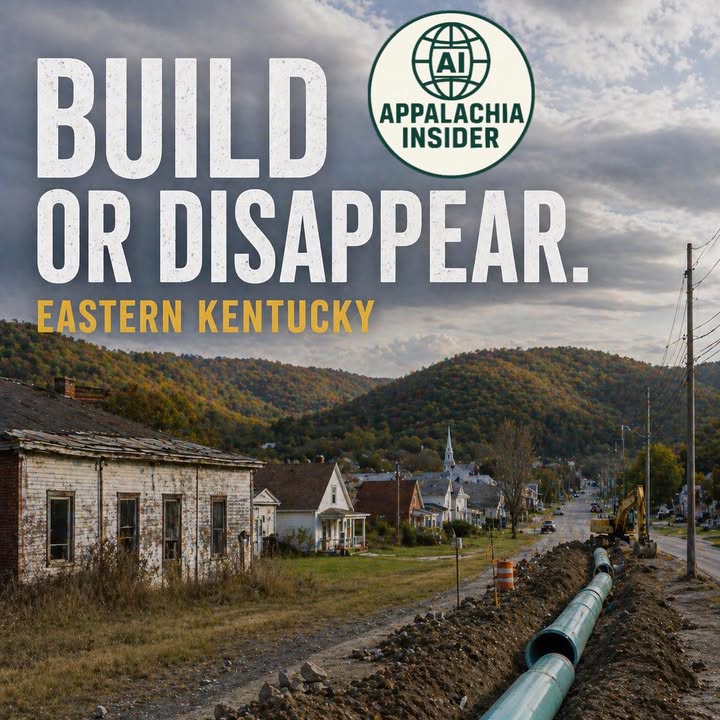
In Eastern Kentucky, we don’t really have a land problem. And we don’t really have a labor problem.
What we have is a water problem, a sewer problem, a housing problem, and an infrastructure problem.
You can still build a house on a hillside with a septic tank. People do it every day. But you cannot build a subdivision. You cannot build apartments. You cannot recruit industry. You cannot grow a town without water and sewer capacity.
So in many places, growth is not limited by people or land. It is limited by infrastructure.
And infrastructure is almost always tied to money. Not just local money, but state and federal money that flows through Frankfort before it ever reaches a place like ours.
Which is why a bill most people will never read matters more than they think.
House Bill 757 is a tax and revenue bill. It changes how Kentucky collects money, when it collects it, and where it puts it. It delays certain corporate tax deductions, redirects some insurance tax revenue into the General Fund, adjusts coal severance tax refund rules, and adds or expands taxes in areas like fantasy sports, prediction markets, and certain digital services. Some of these changes increase state revenue. Some reduce it. But the overall goal is stability. The state is trying to make its revenue more predictable so it can plan and fund projects over the next several years.
That may sound like bookkeeping. But in rural Kentucky, bookkeeping decides what gets built and what doesn’t.
Because a lot of what gets built in Eastern Kentucky depends on money that flows through state agencies. Water projects. Sewer systems. Roads. Industrial sites. Flood control. Agriculture programs. Housing programs. Local government grants. The money often starts at the federal level, moves through Frankfort, and then, if a community is ready, it finally reaches a place like ours.
And here is the part that people need to understand.
Money does not usually go to the places that need it the most. Money goes to the places that are ready to use it.
It goes to the places that already have engineering plans finished, cost estimates completed, permits approved, matching funds lined up, and leadership that can say, “If funded, we can start.”
That is how the system actually works.
So when we talk about a state revenue bill like House Bill 757, what we should really be asking is not just whether the state has money. We should be asking whether Eastern Kentucky is ready.
Because the real problem in Eastern Kentucky has never just been a lack of money.
It has been that for a long time, we have not been organized to capture it.
For decades, we have watched the same cycle repeat. We export coal. We export timber. We export natural gas. We export our young people. The wealth leaves, and then we sit around and ask why nothing ever changes.
But places do not disappear because they are poor. Places disappear because they stop building.
Every town in Eastern Kentucky has a street where there used to be a store, or a factory, or a row of houses full of kids. And now the building is empty, or the houses are gone, or the road is quieter than it used to be. That didn’t happen all at once, and it didn’t happen for just one reason. It happened slowly, over years, as jobs left, as young people left, and as we stopped building the things that make a place feel alive.
Stewardship means we look at every dollar that flows through this region and ask one simple question:
Did we turn that money into something that will still be here in thirty years?
Water systems.
Sewer systems.
Housing.
Industrial buildings.
Childcare centers.
Healthcare facilities.
Roads and bridges.
Local businesses.
Local manufacturing.
Things we can see. Things we can touch. Things we can keep.
Right now, many of the biggest barriers to growth in Eastern Kentucky are not political arguments. They are physical limitations.
In some towns, sewer systems are near capacity, which means large housing developments cannot be built. In some counties, there is not enough quality housing for young families or skilled workers. Some communities do not have build-ready industrial sites. Many parents cannot return to work because there is nowhere to send their children during the day. Some areas struggle to maintain stable EMS and healthcare services.
These are not abstract problems. These are build problems.
And build problems require build solutions.
House Bill 757 does not build anything by itself. But it helps determine whether the money will be there for things to be built in the years ahead. It is a bill about the state’s checkbook. And the state’s checkbook helps determine which regions build and which regions wait.
And here is the truth, whether we like it or not:
The regions that are organized get funded.
The regions that are funded get built.
The regions that get built survive.
The regions that don’t, don’t.
So while Frankfort works on stabilizing the budget, Eastern Kentucky should be working on stabilizing something else: a real plan.
Not ten counties competing against each other.
Not every town trying to figure it out alone.
A regional strategy focused on the things that actually unlock growth:
Water and sewer so housing can be built.
Housing so young families can stay.
Industrial sites so businesses have somewhere to go.
Childcare so parents can work.
Healthcare and EMS so communities feel stable.
Local manufacturing so we produce more than we export.
For a hundred years, Eastern Kentucky has exported resources. Coal. Timber. Gas. Labor. Our children.
Maybe the next chapter is not about what we export.
Maybe the next chapter is about what we build.
House Bill 757 is just a tax bill.
But the future of Eastern Kentucky will be decided by something much simpler than tax policy or politics.
The places that build things survive.
The places that don’t disappear.
The only real question is which one we plan to be.
~CA
OpEd: The preceding information does not necessarily reflect the views of Appalachia Insider as an organization.
#AppalachiaInsider #EasternKentucky #HB757 #Stewardship #BuildDontExport #LocalEconomy #InfrastructureMatters #RuralDevelopment #HousingCrisis #WaterSewerInfrastructure #KentuckyPolicy #Appalachia #CommunityFirst #FutureOfEasternKentucky #PragmaticPath