
OpEd- The Pipe Didn’t Disappear When the Factory Did
Published by Appalachia Insider · May 4, 2026
This opinion piece was contributed to Appalachia Insider. The views expressed are those of the author and do not necessarily reflect the views of Appalachia Insider.
It seems that every time you turn on the news in the last ten years you see the same thing. Another town without clean water. Another boil advisory taped to the refrigerator. Another family standing in a checkout line with a cart full of bottled water in a country that calls itself the most advanced in the world.
You can see it in people’s faces when they talk about it. Not outrage. Not even surprise anymore. Just a tired acceptance. Flint. Jackson. McDowell County. Martin County. Magoffin County. Different maps. Different politics. Same pattern. Aging pipes. Failing plants. Emergency declarations. Promises that this time it will be fixed.
And somewhere inside the explanation, you hear the phrase that is supposed to make it all reasonable.
The deficit.
We are told that decades ago the federal government helped build these systems, but later shifted to loans because Washington had to tighten its belt. The country could not keep writing checks. Spending had to be restrained. Responsibility had to move closer to home.
It sounds disciplined. It sounds mature. It sounds responsible.
But it does not quite hold.
Magoffin County can run out of money. A rural water district can go broke. The federal government cannot. It issues the currency everyone else uses. It does not collect dollars in order to obtain dollars. Federal taxes are not revenue in the way local taxes are. They do not fill a tank so spending can occur. They regulate demand. They cool inflation. They help prevent spending from outrunning real resources.
That does not mean taxes do not matter. It means their role is different.
The real constraint at the federal level is not solvency. It is labor. Steel. Concrete. Skilled operators. Energy. Organization. If those resources exist or can be expanded, the nation has capacity. And if inflationary pressure emerges, taxation exists to remove excess demand and stabilize the system. That is a resource allocation question, not a bankruptcy question.
In the 1970s and into the early 1980s, water and sewer construction was treated like highways. A national project. A shared investment. Federal grants covered the cost because clean water was understood as baseline civilization, not a local luxury. Then the philosophy changed. Grants gave way to loans. Partnership gave way to local math.
At the same time, something else was changing.
The industrial backbone of many of these towns was eroding.
Manufacturing in Appalachia was never accidental. Rail policy shaped it. Energy markets shaped it. Federal procurement shaped it. These towns once built things because national demand made them economically viable. When industry automated, consolidated, and relocated, that was not weather. It was policy, technology, and strategic choice.
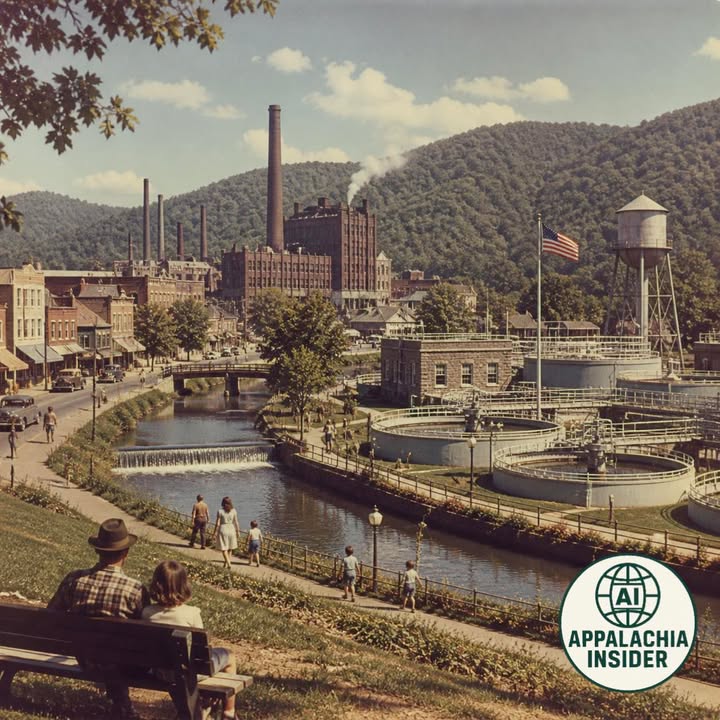
The pipe did not disappear when the factory did.
The treatment plant still needed operators. The lines still needed maintenance. The geography did not flatten. The miles of pipe did not shrink. But the customer base did. The median income did. The margin for error disappeared.
We separated the conversations. Industry became a market outcome. Infrastructure became a local responsibility. Rural counties were told to sustain systems built under national partnership but left behind in economic transition.
And when those systems began to crack, we blamed deficits.
If the federal government can mobilize trillions to stabilize financial markets in a crisis, it can mobilize sustained demand to rebuild industrial anchors in distressed regions. Not as temporary stimulus, but as long-term purchasing guarantees tied to real production. Pipe. Treatment components. Skilled trades. Domestic energy. You create demand with direction. Industry responds. Workforce pipelines follow. Income stabilizes. Rate bases strengthen.
At the same time, baseline utilities in low-density regions should return to a grant-supported model. Not blank checks. Structured grants tied to asset management standards, operator training pipelines, regional consolidation where fragmentation is unsustainable, and transparent performance metrics. If systems fail those metrics, they recalibrate. That is not dependency. That is stewardship.
This is not about expanding the federal footprint. It is about returning it to its purpose. The federal government exists to protect its citizens and improve their lives. Clean water is protection. Functional infrastructure is protection. Stable industry is protection.
If we maintain sweeping authority but allow the foundations of ordinary life to erode in parts of the country, then the problem is not capacity. It is alignment.
Water is not political. It is civilizational. A nation does not collapse all at once. It weakens where the math becomes brittle and no one steps in to steady it.
The pipe did not disappear when the factory did. It stayed in the ground. It still carries water past the same houses, down the same roads, through towns that once built things and believed they would keep building them.
We have the tools. We have the authority. We have the capacity.
What we decide to carry together will determine whether those towns hold.
~CA
Disclaimer: Originally posted 02/23/2026
OpEd: The preceding information does not necessarily reflect the views of Appalachia Insider as an organization.
#AppalachiaInsider #StewardshipEconomics #EasternKentucky #InfrastructureMatters #RebuildAmerica #NationalResilience