
OpEd- The Ridge Corridor Model: A State Trail, Private Land, Local Leverage
Published by Appalachia Insider · February 20, 2026
This opinion piece was contributed to Appalachia Insider. The views expressed are those of the author and do not necessarily reflect the views of Appalachia Insider.
There is $29.5 million in AMLER funding available for coalfield communities. Magoffin will not get all of it. We may not get much of it. We may not get any of it. But counties across Eastern Kentucky are structuring projects to compete.
If we compete, we compete with discipline.
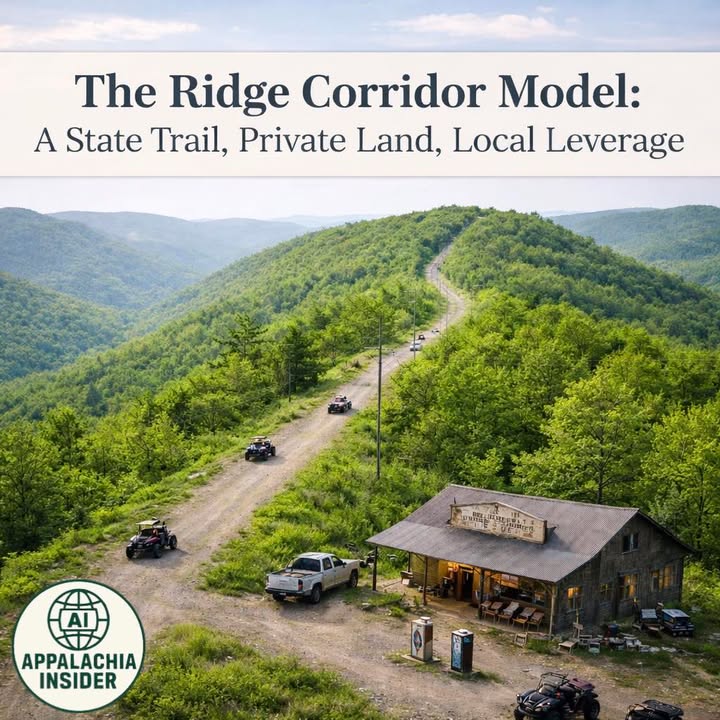
Magoffin already has a functioning asset. The ridge running from Route 30 into Royalton and Tip Top is a state-declared fire trail. It is recognized. It is used. Riders from multiple states are already on it weekly. Four wheelers. Side by sides. Horses.
Demand exists.
But here is the structural reality.
The land is privately owned.
The corridor carries public designation, but the ground belongs to individuals. That means this cannot become a county-owned tourism expansion project without creating long-term fiscal exposure.
Counties do not print money.
Bathrooms, mowing, security, utilities, and maintenance become permanent obligations unless recurring revenue offsets them.
So the ridge must be structured as a coordinated development corridor, not a public recreation buildout.
The fire trail designation gives legitimacy and public visibility. Private ownership preserves flexibility and local equity. The county’s role is not to own the ridge. It is to align landowners, state designation, and regional partnerships into something that produces revenue.
That is where structure matters.
If AMLER is pursued, it should focus on corridor stabilization, drainage, access improvements, and shared utility extensions that unlock multiple parcels. Not ornamental facilities. Not oversized visitor centers.
Public funding should remove bottlenecks.
Private owners should build the income-producing assets.
The ridge is lined with flat reclaimed mine land. That is rare terrain in Eastern Kentucky. Other counties carve development out of hollers. Magoffin can develop along a ridge spine.
Utilities change everything.
Water and electric along the corridor turn it from a trail into an artery. Cabins, campgrounds, barns, repair shops, and event grounds become viable without extreme grading costs.
But here is the discipline layer.
Infrastructure should only extend where private development intent exists. If utilities are run without committed investment, we have simply improved private property without building revenue capacity.
If utilities are paired with development agreements, we unlock commerce.
First Frontier Appalachian Trails becomes a strategic multiplier. FFAT is actively looking to expand Magoffin’s system. Integration into their mapping and promotion network reduces marketing burden and plugs the ridge into a broader regional flow. That lowers risk and increases traffic without Magoffin carrying branding alone.
But traffic alone is not wealth.
Revenue structure is.
Event permits. Vendor licenses. Coordinated usage agreements. Maintenance contributions tied to commercial operations. Possible tourism tax capture where applicable.
The corridor must pay for its own upkeep over time.
Tourism cannot become Magoffin’s backbone. It can accelerate cash flow. It cannot replace production. The ridge must remain flexible for mixed commercial uses as it matures.
The test is simple.
Does this corridor increase locally owned business income?
Does it raise property values without increasing county liability?
Does it generate recurring revenue sufficient to sustain maintenance?
If the answer is no, we scale back.
We may not secure AMLER funding.
But even without it, the combination of state trail designation, private ownership, and First Frontier partnership gives Magoffin leverage most counties would envy.
The ridge already exists.
The designation already exists.
The traffic already exists.
The difference between a trail and an engine is structure.
The funding may or may not come.
The model has to work either way.
~CA
OpEd: The preceding information does not necessarily reflect the views of Appalachia Insider as an organization.
#MagoffinCounty #EasternKentucky #TrailEconomy #StewardshipEconomics #FirstFrontier #AppalachiaInsider