
THE COLE NATION: LIFE ALONG BIG LICK IN MAGOFFIN COUNTY
Appalachia Insider · November 24, 2026
Part Three of an Appalachia Insider Special Series
Along Big Lick Branch in Magoffin County, there once stood a community whose history was documented in newspapers across the country, recorded in federal census records, and preserved through generations of family relationships.
Its residents had homes, a schoolhouse, places of worship, and the same concerns that occupied families throughout the mountains of Eastern Kentucky. They raised children, worked their land, participated in local government, and built lives within the hollows that surrounded them.
But there was something about this particular settlement that distinguished it from many of its neighbors.
Its residents belonged to an interconnected population of Indigenous families whose ancestors had traveled through several states before establishing permanent homes in Eastern Kentucky.
By the late nineteenth century, the settlement was known locally as the Cole Nation.
Today, its descendants are part of the Salyersville Indian Community, whose history has been preserved through extensive genealogical research, historical records, and the memories of the families themselves.
And while much of the settlement has changed with time, the surviving documentation allows us to look beyond names and dates to better understand the people who called Big Lick home.
THE MAKING OF A COMMUNITY
As explored in Part Two of this series, the families associated with the Salyersville Indian Community did not arrive in Eastern Kentucky together in a single migration.
Their ancestors moved through Virginia, North Carolina, and Tennessee over several generations, establishing relationships through marriage and shared settlements before portions of those families continued into Kentucky.
By the early nineteenth century, members of the Cole, Collins, and Gibson families were living in the region that would eventually become Magoffin County.
During the decades preceding the Civil War, these families began purchasing land around Big Lick, Cole Creek, Bear Branch, and Jenny’s Creek, near the present-day boundaries of Magoffin, Floyd, and Johnson counties.
The land purchases gave the families something they had not always possessed during their earlier movements through the Appalachian frontier: a more permanent geographic home.
The settlement was not necessarily a village in the modern sense, with houses arranged around a central square. Rather, it consisted of interconnected households spread throughout the creeks and hollows, many occupied by relatives whose family relationships extended back generations.
The Cole family became particularly prominent around Big Lick, while related Collins and Gibson families maintained residences in surrounding areas.
As families grew, marriages continued connecting households, and children were raised among relatives who shared much of the same ancestry and history.
Over time, these relationships helped establish a distinct community within the larger population of Eastern Kentucky.
The families were not isolated from the surrounding county. They owned land, paid taxes, participated in elections, and maintained relationships with their neighbors.
But they also continued to recognize one another as belonging to a connected Indigenous population.
THE SCHOOLHOUSE, THE STORE, AND THE FORKS
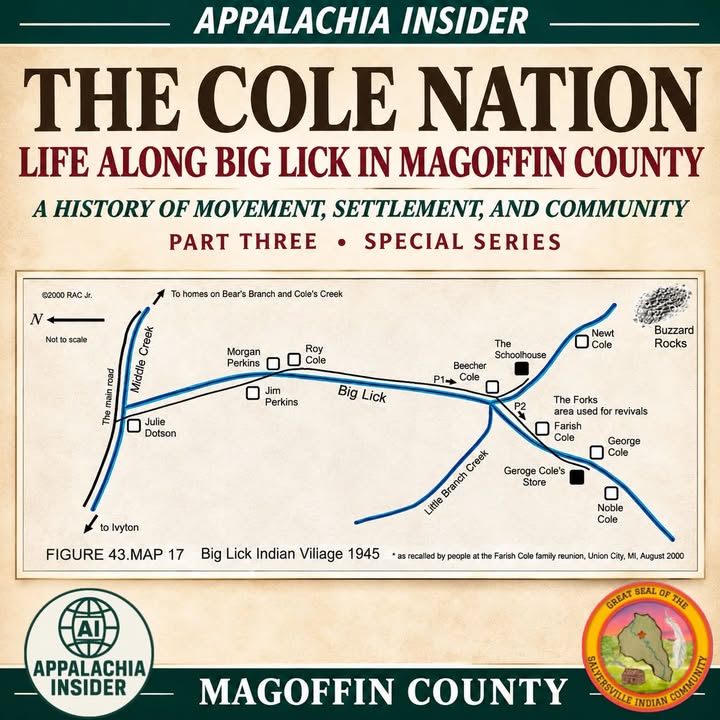
One of the most revealing pieces of historical material preserved by the Salyersville Indian Community is a reconstructed map of the Big Lick settlement.
Created by anthropologist Dr. Richard Allen Carlson Jr. using family recollections shared during a Cole family reunion in 2000, the map identifies residences, landmarks, and gathering places within the historic community.
Among them are a schoolhouse, George Cole’s store, and an area known as the Forks, where religious revivals and community gatherings took place.
These details provide a glimpse into the everyday institutions that connected the families.
Education was part of life along Big Lick. The community maintained a small schoolhouse, and a newspaper account from October 1901 described a school district with 53 pupils, 37 of whom were present during the reporter’s visit.
The school continued serving the area for decades, with Carlson’s research documenting its existence into the twentieth century.
George Cole’s store was another familiar place within the settlement, identified in the community’s historical reconstruction as a gathering point.
Religion also played an important role in the lives of Big Lick residents.
Christian worship had long been associated with the families whose ancestors formed the community, and by the turn of the twentieth century, religious gatherings and revivals were prominent features of local life.
The Forks at Big Lick became a location for outdoor religious services, some attracting residents from outside the Indigenous community.
The settlement’s churches, school, store, and family homes were not simply structures or locations on a map. They were places where relationships were maintained, children learned, neighbors gathered, and generations of family history unfolded.
And through those institutions, the community developed an identity that extended beyond any single household.
CHIEF TINEY COLE AND THE COLE NATION
By the beginning of the twentieth century, one of the settlement’s best-known residents was Valentine “Tiney” Cole.
Known in historical accounts as Chief Tiney Cole, he was a son of William “Old Billie” Cole and a descendant of the families who had established the community during the nineteenth century.
His father’s name appeared frequently in historical accounts of the population, including reports identifying Old Billie as a Catawba chief. That specific tribal affiliation remains unconfirmed in the genealogical research available today, but the accounts demonstrate how outsiders understood and described the family at the time.
Chief Tiney became a recognizable representative of the Big Lick settlement.
On September 17, 1901, The Paducah Sun published an article identifying the community as the Cole Nation.
The St. Louis Post-Dispatch followed with reporting later that month.
Then, on October 7, 1901, the Nashville American published a more detailed account of the settlement, including an interview with Chief Tiney and descriptions of the families living along Big Lick.
(EDITOR’S NOTE: During our research into this series, Appalachia Insider discovered that the October 7, 1901 article, previously attributed in Part One to The Tennessean, was actually published in the Nashville American. The original attribution appeared in historical research materials used for the series. Further investigation confirmed the correct publication. We acknowledge and correct that earlier error.)
The newspaper described a community whose residents were connected through several generations of family relationships and whose Indigenous identity was recognized by people familiar with the area.
Its reporting also provides smaller details that make the settlement’s history particularly interesting.
The newspaper noted that many residents shared the same given names, leading families and neighbors to distinguish individuals through nicknames.
Among the examples were Old Valentine and Young Valentine, Bug Adam and Little Adam, and several men named George or John who were identified by additional names.
It is a familiar custom in Eastern Kentucky, where generations of relatives often share names and where a nickname can become more recognizable than the name recorded on a birth certificate.
The 1901 account also described homes, family relationships, and the community schoolhouse, offering details rarely found in ordinary census records.
The language used by some early reporters reflected the stereotypes and prejudices of their time. Descriptions of the community were sometimes condescending, particularly when discussing the residents’ living conditions or cultural identity.
Those characterizations deserve to be understood in their historical context rather than accepted as objective assessments of the people being described.
Nevertheless, the reports provide contemporary evidence of a population that identified as Indigenous and was recognized as a distinct community by outsiders.
For a settlement located deep within the mountains of Eastern Kentucky, its appearance in newspapers across several states is an indication that its existence was known well beyond Magoffin County.
MORE THAN A NAME ON A CENSUS
Perhaps the most significant surviving records of the community are the federal census schedules.
In 1900, the Salyersville District included a separate Indian Population Schedule identifying 83 residents in 15 households, according to Carlson’s analysis.
The families were concentrated primarily around Big Lick and nearby waterways, although other relatives lived elsewhere throughout the region.
Those numbers should not be mistaken for a complete accounting of everyone connected to the community.
Historical census takers did not always classify members of these families consistently.
In some decades, relatives were recorded as Indian. In others, they were identified as white or placed under other racial classifications used by the government at the time.
Even people belonging to the same extended families could be classified differently depending upon where they lived and who conducted the census.
By 1910, the federal census again included a separate Indian Population Schedule for the Salyersville District, with the enumerator identifying many residents as Cherokee.
That designation is part of the historical record, although it does not independently establish Cherokee tribal ancestry.
The community’s current federal acknowledgment petition instead emphasizes its documented connections to the historical Saponi and the development of the distinct Salyersville Indian population.
These records are important not simply because they contain names, but because they show that the community was being documented by government officials while its members continued living in identifiable family groups.
They also help researchers connect subsequent generations to the families who established the settlement.
A PLACE WITHIN MAGOFFIN COUNTY
The Cole Nation was not entirely separate from the political and civic life of Magoffin County.
Carlson’s research identifies two members of the extended Cole family, brothers Wallace and Shepard Cole, who were elected Justices of the Peace in local districts.
Their participation in county government illustrates that members of the community held public responsibilities and exercised influence beyond their immediate family settlements.
The families also continued acquiring property, raising children, participating in local religious life, and maintaining economic relationships with neighboring communities.
Their everyday experiences were shaped by many of the same circumstances confronting other Eastern Kentucky residents.
Land, work, education, religion, and family obligations occupied much of their lives.
But the preservation of their Indigenous identity, even as governmental classifications and economic circumstances changed, distinguished their collective history.
That identity was sustained through family relationships rather than through an uninterrupted modern tribal government.
For generations, relatives continued recognizing their connections to one another, maintaining an understanding of shared ancestry and belonging that would eventually become central to the modern Salyersville Indian Community.
THE PEOPLE BEHIND THE HISTORY
It is easy to study an old settlement through census figures, property records, and newspaper articles without considering the ordinary lives those documents represent.
The Big Lick records describe children attending school, families gathering for worship, neighbors visiting a store, and relatives building homes along the same waterways.
They describe people who participated in the life of Magoffin County while maintaining a community identity rooted in generations of shared relationships.
And perhaps that is what makes the Cole Nation’s history especially relevant today.
The people documented in those records were not distant figures living in some unfamiliar place. They were residents of the same mountains, creeks, and hollows that generations of Eastern Kentuckians have called home.
Their descendants continued living in Kentucky and elsewhere, preserving family connections long after the original settlement began changing.
Some of the land remained in family ownership. Other families eventually moved away in search of employment, establishing new communities while maintaining ties to Magoffin County.
The Salyersville Indian Community’s modern historical archives preserve photographs, maps, records, and family accounts that help connect those generations.
Today, those materials provide something the earliest newspaper reporters could not: an opportunity to examine the community’s history through records gathered and preserved by its own descendants.
The Cole Nation was more than a name used by outsiders.
It was a community of families whose lives became part of the history of Magoffin County.
And the story did not end when the newspapers stopped writing about it.
In the next installment, Appalachia Insider will examine the early twentieth-century efforts by members of the community to establish their claimed Cherokee ancestry through a federal enrollment process, including the investigation that brought a government representative into the mountains of Magoffin County.
That chapter would introduce another significant turning point in the community’s long history of seeking recognition.
Part Three of an Appalachia Insider special series examining the history, people, and future of the Salyersville Indian Community.
Sources: Richard Allen Carlson Jr., Who’s Your People? (2003); Carlson, Salyersville Indian Community Concise Written Narrative for Petition for Acknowledgment as an Indian Tribe (2025); Salyersville Indian Community Tribal Government and Historical Archives, A Brief History of the Salyersville Indian Community (2026); Nashville American, October 7, 1901; historical census and newspaper records reproduced or referenced in those works.
#AppalachiaInsider #SalyersvilleIndianCommunity #ColeNation #MagoffinCounty #BigLick #EasternKentucky #NativeAmericanHistory #AppalachianHistory